

Diverse group of Americans including a mother with child, elderly man, pregnant woman, and person in wheelchair standing in front of a medical facility holding an insurance card
Medicaid Insurance Guide for Adults and Families

Content
Millions of Americans rely on Medicaid when private insurance premiums stretch beyond their budget. While Medicare handles healthcare for seniors (primarily those 65+), Medicaid targets a different group: families with limited income, expectant mothers, kids, and individuals living with disabilities. Getting a handle on how this program operates? That knowledge can literally determine whether you receive medical treatment or skip it entirely.
We'll walk you through who qualifies, how to actually get enrolled, what your coverage includes, and the tricks to keeping your benefits active year after year.
How Does Medicaid Insurance Actually Work?
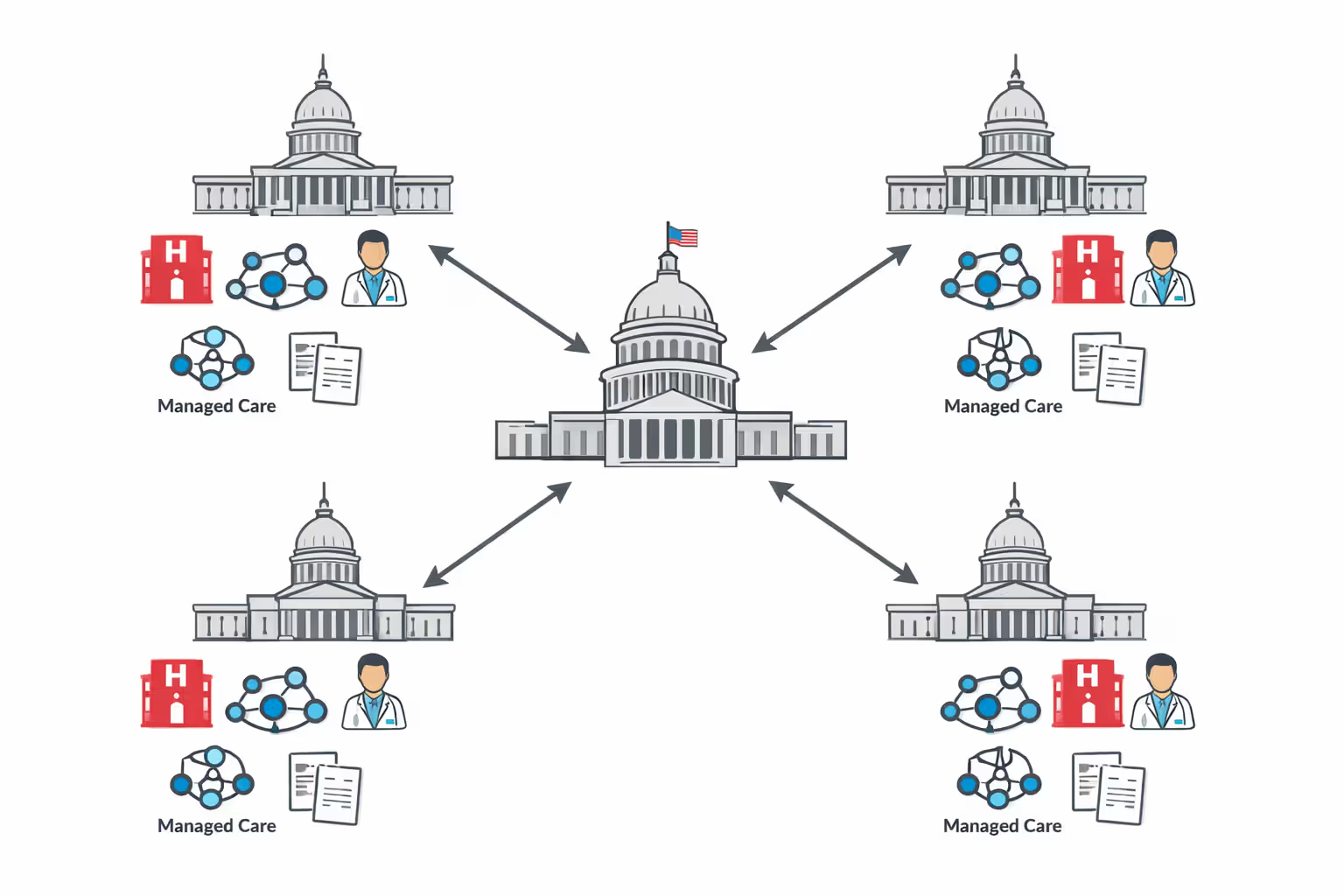
Medicaid functions as a partnership between Washington and state capitals to cover healthcare costs for qualifying low-income residents. Here's the setup: federal officials establish the ground rules and write checks to states, but each state runs its own version of the program within that framework. Why does this matter? Coverage in California looks nothing like coverage in Alabama—different income cutoffs, different benefits, different rules altogether.
The payment structure separates Medicaid from commercial insurance plans. You won't write a monthly premium check if you're in the standard eligibility groups. Some providers accept lower reimbursement rates from Medicaid than they'd get from Blue Cross or Aetna, which sometimes makes it harder to find participating doctors. Emergency rooms, though? They'll treat you regardless of your insurance situation.
States choose between several administrative models. Managed care contracts are popular—states pay insurance companies a flat monthly amount per enrollee, and those companies handle all the care coordination (think along the lines of an HMO structure). The older fee-for-service approach has states cutting individual checks to doctors and hospitals for each appointment or procedure. Increasingly, you'll see states mixing both systems: managed care dominates in cities like Houston or Philadelphia, while rural counties in Montana or Mississippi stick with fee-for-service because managed care companies won't operate there.
Author: Melissa Grant;
Source: blaverry.com
Congress mandates that states cover specific groups and medical services, but that's just the floor. States can—and many do—go further. The Affordable Care Act introduced an expansion option for adults earning up to 138% of poverty guidelines. As of 2026, 41 states plus D.C. have taken that deal. The holdout states? They're using pre-2014 eligibility standards that lock out most childless adults entirely.
Who Actually Qualifies for Medicaid Insurance?
Medicaid insurance eligibility isn't something you can buy your way into like a marketplace plan. You've got to demonstrate financial need by meeting strict requirements around income, family size, and which category you fall into.
Several distinct groups get coverage. Parents raising kids can qualify at thresholds each state sets independently. Pregnant women get covered throughout pregnancy plus a full year after delivery (in states that adopted the extended postpartum option). Kids qualify at much higher income levels than their parents—frequently 200% or even 300% of poverty. Individuals collecting Supplemental Security Income due to disabilities? They're automatically enrolled in most states. Seniors meeting both income and asset tests use Medicaid to supplement Medicare by covering premiums and filling coverage gaps.
Expansion states created the simplest path: adults aged 19-64 earning under 138% of poverty guidelines qualify, period. No disability required. No kids needed. Non-expansion states wall off coverage—typically you need to be a parent earning under 50% of poverty (sometimes as low as 25%), and childless adults hit a dead end unless they're pregnant or disabled.
What Income Levels Allow Medicaid Enrollment by Household Size?
Federal poverty calculations get adjusted each year for inflation. States reference these numbers when setting eligibility cutoffs. Here's what the 138% FPL threshold looks like for expansion states in 2026:
| Household Size | Annual Earnings Cap | Monthly Earnings Cap |
| 1 person | $20,783 | $1,732 |
| 2 persons | $28,207 | $2,351 |
| 3 persons | $35,631 | $2,969 |
| 4 persons | $43,055 | $3,588 |
| 5 persons | $50,479 | $4,207 |
| 6 persons | $57,903 | $4,825 |
Now compare that to non-expansion states, where things get brutal. Texas requires parents of two to earn under $3,900 yearly—yes, annually—to qualify. Childless adults in Texas? Zero pathway to Medicaid, regardless of income. Always verify your state's specific cutoffs since these figures only reflect the expansion threshold.
What counts as income? Paychecks from your job, profits from self-employment, Social Security checks, unemployment payments, alimony—basically everything. However, Medicaid uses Modified Adjusted Gross Income rules, which exclude certain items. Supplemental Security Income doesn't count. Veterans disability payments typically don't count. The MAGI calculation matters because it can make the difference between qualifying and getting denied.
Special Rules for Adults Without Kids
Childless adults face Medicaid insurance requirements that are downright harsh in non-expansion states. Without the Medicaid expansion, this population must meet disability criteria comparable to qualifying for Social Security Disability Insurance—an incredibly high bar. This creates what policy experts call the "coverage gap": earning too much for Medicaid but too little to afford marketplace plans, even with subsidies helping.
Expansion states opened the door for this group, though some attached strings. A handful of states got federal permission to impose work requirements—80 hours monthly of employment, job training, or volunteer work. Montana implemented this before COVID, though enforcement has been inconsistent and legal challenges keep these requirements in flux. Exemptions exist for students, people caring for disabled family members, and those with medical conditions preventing work.
A few states built alternative programs for specific adult populations outside standard Medicaid. New York's Family Health Plus serves certain adults in unique circumstances. California extended eligibility to undocumented immigrants through age 49 who meet income standards. These state-funded expansions highlight just how dramatically Medicaid insurance eligibility differs depending on your ZIP code.
Getting Through the Medicaid Application Process
The medicaid insurance application process has gotten considerably easier since 2014, though complexity hasn't vanished. Multiple doorways exist: your state Medicaid website, HealthCare.gov (which forwards your information to your state), phone applications, mailed paper forms, or face-to-face help at county social services offices.
Online applications usually consume 30-45 minutes of your time. You'll enter Social Security numbers for household members seeking coverage, documentation showing recent income (past month or two), and details about any current insurance. Here's something that surprises people: you don't prove citizenship when applying—you simply check a box attesting to it, though verification requests might arrive later.

Author: Melissa Grant;
Source: blaverry.com
Household composition questions trip people up constantly. For Medicaid calculations, your household includes: you, your spouse if living together, children under 19 (even if they live elsewhere), and anyone claimed on your tax return as a dependent. This differs from "who lives at your address" and significantly impacts eligibility determinations.
Documentation requirements shift based on your employment situation. Employees should submit recent pay stubs. Self-employed folks may need a profit-and-loss statement or the prior year's 1040. Unemployed with zero income? You'll attest to that fact, though states may dig deeper if other application information doesn't align with a claim of no income.
How long until you get an answer? Federal regulations mandate decisions within 45 days for standard applications, 90 days when disability determinations are involved. Reality varies—many states process straightforward applications within 10-14 days. Applications dragging past those federal deadlines? Call your state Medicaid office. You might qualify for retroactive coverage backdated to your application date once approved.
Delays usually trace back to incomplete submissions or ignored verification requests. States mail notices requesting additional documentation, but letters get sent to outdated addresses or buried in mail piles. Setting up online account access lets you monitor application status and upload documents electronically rather than playing postal service roulette.
Denials aren't necessarily final. Read that denial letter thoroughly. The stated reason might be fixable—missing paperwork, math errors in income calculations, household size confusion. Appeal rights come with every denial, typically 90 days from the denial date. Approval rates on appeals run surprisingly high when applicants submit the missing puzzle pieces or correct state errors. Community health centers and legal aid organizations offer free help navigating appeals.
What Medical Services Get Covered Under Medicaid?
Medicaid insurance benefits encompass comprehensive medical care, though your state determines the specifics. Federal regulations mandate certain services while allowing states to add optional coverage.
Every state must cover: hospital care (both inpatient stays and outpatient procedures), doctor visits, lab work and X-rays, nursing facility services for adults, home health visits, and preventive care including shots. Prescription medications are technically optional but all 50 states provide drug coverage. Emergency services receive coverage even when you're traveling outside your home state.
Doctor appointments and specialist consultations fall under covered services, though managed care plans may require referrals before you can see a specialist. Primary care visits typically carry no out-of-pocket cost, while specialist appointments might cost you $3-$5 in states charging copayments. Preventive care—your annual physical, cancer screenings, immunizations—comes with zero copayments.
Hospital services span emergency room treatment, overnight admissions, surgical procedures, and outpatient services. Get admitted? Medicaid covers your entire stay, including every medication administered during hospitalization. Ambulance transportation gets covered when medically warranted, and that definition extends beyond life-threatening emergencies.
Mental health and substance abuse treatment have expanded substantially under parity laws. Outpatient therapy sessions, psychiatric medications, intensive outpatient programs, and psychiatric hospital admissions all receive coverage. Medication-assisted treatment for opioid addiction became a mandatory benefit in expansion states—covering medications like buprenorphine along with counseling.
Dental and vision benefits for adults? This is where state variation gets extreme. Federal requirements mandate these services for kids but make them optional for adults. Roughly half of states provide comprehensive dental coverage—cleanings, fillings, root canals, dentures. Another chunk covers only emergency dental work like pulling an infected tooth. The remainder offers essentially emergency-only services.
Vision coverage follows similar fault lines. Some states cover annual eye exams plus glasses or contacts. Others provide exams only when medically indicated (diabetics monitoring for retinopathy, for example) without covering corrective lenses. Check your state's specific benefits since this represents one of the widest gaps in Medicaid insurance for adults.
Pregnancy care receives comprehensive coverage everywhere—prenatal appointments, labor and delivery, postpartum visits. Recent federal changes extended postpartum coverage from 60 days to 12 months in states adopting this expansion, addressing maternal mortality crisis concerns.
Long-term care—nursing homes and home health services—represents one of Medicaid's most significant benefits for elderly and disabled enrollees. Medicare doesn't cover long-term nursing home stays, making Medicaid the nation's primary payer for nursing facility care.
Medicaid serves as the bedrock of healthcare access for vulnerable populations.When states restrict eligibility or reduce benefits, we see immediate impacts on emergency room utilization and untreated chronic conditions, which ultimately costs the healthcare system more
— Dr. Rachel Hammond
Keeping Your Medicaid Coverage Active Through Renewal
States conduct medicaid insurance renewal—called redetermination—once yearly. During COVID's public health emergency, continuous coverage protections prevented anyone from losing Medicaid. When those protections expired, states resumed normal redetermination processes, and millions lost coverage—often for paperwork reasons rather than actual ineligibility.
Expect a renewal notice 60-90 days before your coverage end date. This might arrive by mail or appear in your online account, depending on communication preferences you selected. The renewal form asks you to confirm or update: income, who lives in your household, and current contact information.
Meeting that deadline is absolutely critical. Countless people lost coverage simply because renewal forms never got returned, despite remaining eligible based on income and household size. When circumstances haven't changed since your last renewal, the process often requires nothing more than a signature and date. Changed income or household size? You'll submit updated documentation.
States now attempt to verify information before bothering you. This "ex parte" renewal process cross-checks wage databases, Social Security records, and similar sources. When the state can confirm continued eligibility without your input, coverage renews automatically and you receive a notice that you're covered for another year.
When automated verification fails, expect a request for specific information. Common asks include: current pay stubs, an employer letter confirming wages, or recent bank statements. Time matters here—you typically get 10-30 days depending on your state's policies. Missing this deadline represents the single most common reason people lose coverage at renewal despite remaining eligible.
Report life changes promptly, even between annual renewals. Significant income increases might bump you off Medicaid but qualify you for subsidized marketplace plans instead. Continuing to use Medicaid after becoming ineligible can trigger repayment demands for services received post-ineligibility. Conversely, income drops might qualify you for benefits previously unavailable.
Address changes cause more problems than you'd expect. Renewal notices mailed to your old apartment mean you won't realize a response is needed. Update your address immediately when moving—through your online account, by phone, or via written notice to your state agency.
Document everything you submit. If your state claims they never received your renewal paperwork or verification documents, having copies with submission dates protects you. Many states now allow document uploads through online portals that automatically generate receipt confirmations.

Author: Melissa Grant;
Source: blaverry.com
Application Mistakes That Cause Delays and Denials
Incomplete applications cause unnecessary hassles and denials. Applicants frequently skip confusing questions or leave sections blank, assuming the agency will reach out for clarification. Reality check: incomplete applications trigger denials, forcing you to start over or file an appeal. Confused by a question? Call your state's Medicaid helpline or visit a local enrollment assistance organization rather than guessing or leaving blanks.
Income reporting mistakes happen constantly. Some applicants report gross income when they should report net, or vice versa. Others forget to include income from all household members. Self-employed individuals struggle estimating monthly income when earnings fluctuate wildly between months. When uncertain, estimate slightly high—approval based on higher reported income clearly establishes eligibility; underestimating and having actual income exceed limits could trigger repayment demands.
Blown documentation deadlines cause more coverage losses than actual ineligibility. States send verification requests with firm deadlines—frequently just 10 days. Need additional time? Call and request an extension before the deadline expires. Many states grant reasonable extensions, but only when asked before deadlines pass.
Failing to report life changes creates serious problems. New job? Income change? Household member moving in or out? Access to employer insurance? You're required to report changes within 10 days in most states. Non-reporting can result in overpayments requiring repayment, or conversely, missing out on benefits you newly qualify for.
Asset limit confusion affects specific Medicaid categories. The adult expansion category and most parent categories ignore assets—only income matters. However, elderly and disabled individuals seeking long-term care benefits face strict asset tests, typically $2,000 for singles and $3,000 for couples. Applicants sometimes give away assets thinking it'll help them qualify, not realizing this triggers penalty periods of ineligibility. Consulting an elder law attorney before making asset transfers is money well spent.
Treating denials as final prevents many eligible people from accessing coverage. Get denied? Read that denial notice carefully. Frequently the reason is correctable—forgotten pay stub, incorrect household size calculation, state miscalculation errors. Appeal rights accompany every denial, and approval rates for appeals are surprisingly high when applicants provide missing documentation or correct calculation errors.
Frequently Asked Questions About Medicaid Insurance
Medicaid insurance delivers essential health coverage to millions of Americans who'd otherwise skip medical care entirely. Understanding who qualifies, how to navigate enrollment, and maintaining coverage through timely renewals prevents gaps that could leave you vulnerable to crushing medical debt or deteriorating health conditions.
The program's state-by-state structure means your experience depends heavily on geography. Expansion state residents generally encounter simpler eligibility standards and broader benefits than non-expansion state residents. Regardless of location, successful enrollment hinges on submitting complete and accurate information, responding promptly to any state agency requests, and reporting circumstance changes as they occur.
Think you might qualify? Apply. Worst case scenario: a denial you can appeal. Best case: access to healthcare that improves your quality of life and financial security. Community health centers, legal aid organizations, and certified application counselors provide free assistance when you need help navigating the process.