

Family of four sitting at kitchen table reviewing health insurance options on laptop with documents, bright modern kitchen
ACA Subsidies Guide for Health Insurance Savings

Content
Every year, eligible families forfeit $3,000 to $10,000 in federal assistance simply because they don't realize they qualify for marketplace tax credits. Even folks who've checked before should look again—recent expansions mean households earning $125,000 now receive help paying premiums.
Think you make too much? A Colorado family earning $95,000 recently discovered they qualified for $650 monthly in assistance. Self-employed workers often qualify too, since business deductions lower the income calculation. Whether you're between jobs, working part-time gigs, or your employer's plan costs a fortune, these federal credits might cut your health insurance bill by 60-80%.
Let's break down who gets this money, how to claim it, and why some applicants end up owing thousands back to the IRS.
What Are ACA Subsidies
Federal tax credits for marketplace health plans come in two flavors: monthly premium discounts and reduced out-of-pocket maximums. Both originated from the Affordable Care Act passed in 2010, though recent changes expanded who can claim them.
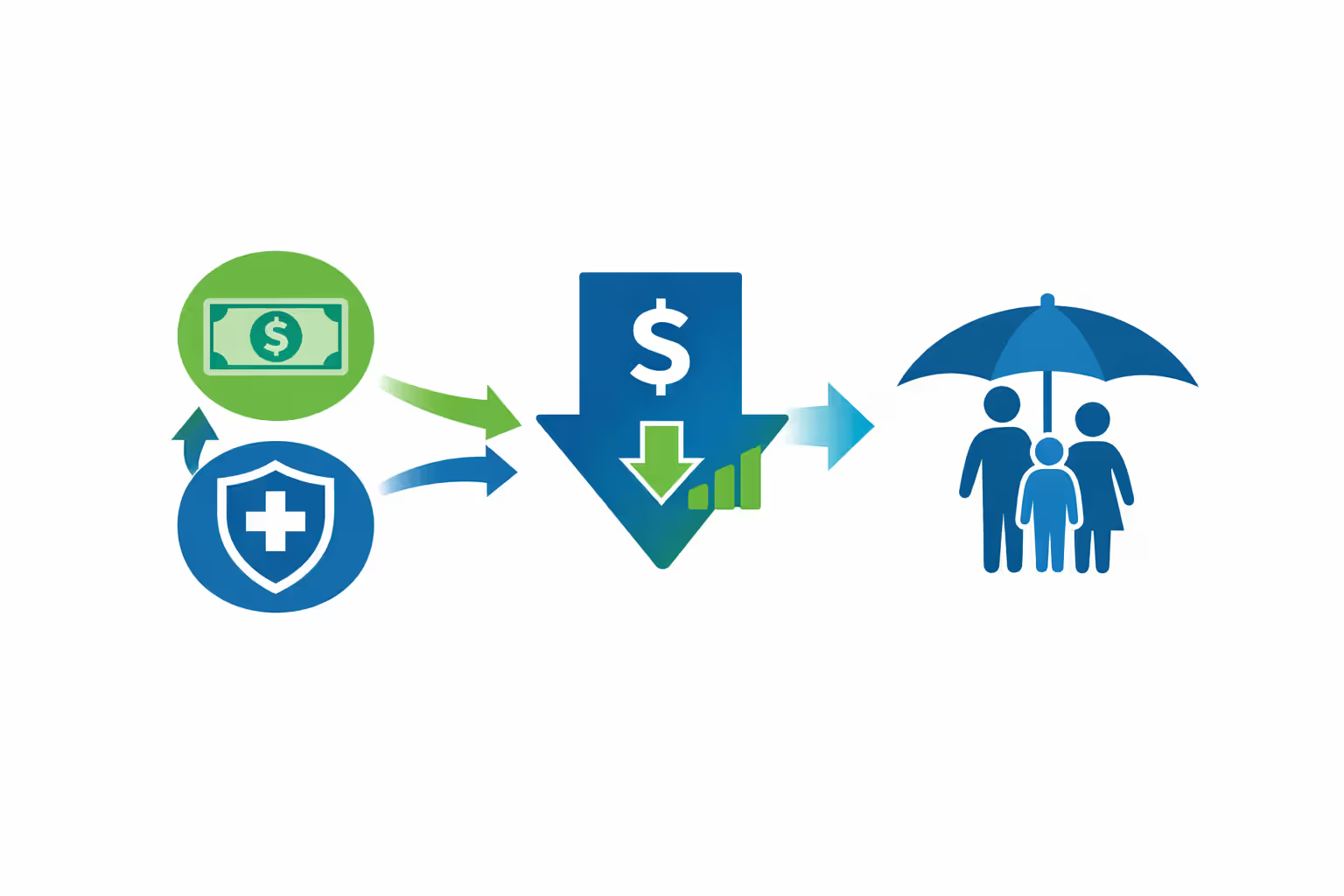
The monthly discount—officially called the premium tax credit—works like a coupon applied to your insurance bill. Instead of paying $900 for coverage, you might pay $200 after the government chips in $700. Most folks apply this credit immediately each month rather than waiting until tax season for a refund.
Reduced deductibles and copays represent the second subsidy type, available exclusively on Silver-tier marketplace plans. Qualify for these cost-sharing reductions, and your $5,000 deductible might shrink to $500. Your $50 specialist copay drops to $10. These extras only kick in when your earnings fall between 100% and 250% of federal poverty guidelines.
When people reference aca healthcare or aca insurance, they're talking about policies sold through official state and federal exchanges that meet minimum federal standards. The aca meaning encompasses more than subsidies—it includes protections against denial for pre-existing conditions, required coverage for maternity care and mental health, and the elimination of lifetime benefit caps.
Subsidies power the entire marketplace system. Strip them away, and premium costs would consume 15-20% of typical household budgets—forcing millions to drop coverage entirely.
Author: Ethan Bradford;
Source: blaverry.com
How ACA Subsidies Work
Your discount amount gets calculated using the second-cheapest Silver plan available in your county—called the benchmark plan. If that benchmark costs $600 monthly and the government determines you should pay $150, you'll receive $450 in monthly credits.
Here's the interesting part: you can spend that $450 credit on any metal tier. Choose a Bronze plan priced at $380? Your net cost drops to zero ($380 minus $450 means the insurer can't charge you below $0). Want a Gold plan listed at $720? You'd pay $270 monthly ($720 minus your $450 credit).
The percentage you're expected to contribute climbs alongside your income. Someone earning 150% of poverty level contributes roughly 2-4% of their income toward premiums. At 350% of poverty level, that jumps to 8-10%. Federal dollars bridge the gap between your contribution and the benchmark price.
Advance payment sends your credit straight to the insurance carrier before you ever see it. Your monthly invoice already reflects the discount. Come April 15th, the IRS compares what you received against what you deserved based on actual yearly income. Earned more than projected? You'll owe some back. Earned less? Expect an additional refund.
Mid-year income swings create the biggest headaches in understanding how does aca subsidies work. Land a promotion, sell a rental property, or watch your spouse's freelance income double, and your subsidy amount shifts. The marketplace lets you report these changes immediately, adjusting your advance credit to prevent tax-time sticker shock.
Of all the forms of inequality, injustice in health care is the most shocking and inhumane
— Martin Luther King Jr
Who Qualifies for ACA Subsidies
Four requirements determine whether you can claim marketplace tax credits: where your income lands, how many people live in your household, your immigration status, and whether someone else already offers you decent coverage.
Your Modified Adjusted Gross Income must fall between 100% and 400% of the Federal Poverty Level to claim premium credits. (Medicaid covers people below 100% in states that expanded the program.) MAGI takes your adjusted gross income from line 11 of your 1040, then adds back certain deductions like foreign income exclusions and tax-exempt interest. For most W-2 employees, your MAGI essentially matches your AGI.
Household size counts you, your spouse if you're filing jointly, and any tax dependents you claim. Four-person families enjoy much higher income ceilings than single filers. This sometimes confuses people: your 26-year-old son who lives in your basement but files his own taxes doesn't count toward your household size, even though he's eating your food and using your Netflix.
Citizenship rules require either U.S. citizenship or lawful presence. Undocumented residents can't receive subsidies, though their American-born children qualify. Green card holders qualify immediately upon arrival, while certain visa categories require five-year waiting periods.
Job-based coverage restrictions surprise many applicants. When your employer provides health insurance costing less than 9.12% of household income for employee-only coverage in 2026, you typically can't claim marketplace subsidies—even when adding your family to that employer plan would cost $1,200 monthly.

Author: Ethan Bradford;
Source: blaverry.com
Income Limits for 2024–2025
For 2026 coverage, poverty level guidelines set the boundaries. Single people earning up to $60,240 yearly (400% FPL) qualify for premium assistance. That ceiling jumps to $124,800 for four-person households.
| Household Size | 100% FPL | 150% FPL | 200% FPL | 250% FPL | 300% FPL | 400% FPL |
| 1 | $15,060 | $22,590 | $30,120 | $37,650 | $45,180 | $60,240 |
| 2 | $20,440 | $30,660 | $40,880 | $51,100 | $61,320 | $81,760 |
| 3 | $25,820 | $38,730 | $51,640 | $64,550 | $77,460 | $103,280 |
| 4 | $31,200 | $46,800 | $62,400 | $78,000 | $93,600 | $124,800 |
Inflation pushes these numbers upward every January. Reduced deductibles phase out at 250% FPL, meaning a single person earning $37,700 receives premium help but pays standard Silver plan deductibles instead of reduced ones.
Special Circumstances That Affect Eligibility
Self-employment creates interesting opportunities. You can subtract business expenses before calculating MAGI, potentially dropping your income low enough to qualify. A graphic designer showing $58,000 in revenue but $15,000 in legitimate expenses would calculate eligibility using $43,000.
Early retirees get blindsided by retirement account withdrawals counting as income. Take $40,000 from your 401(k) to cover living expenses, and that $40,000 gets added to your Social Security and investment income—possibly pushing you over subsidy limits.
Seasonal work complicates projections. If your income swings from $2,000 monthly in winter to $8,000 during summer, estimate conservatively. Better to receive a smaller monthly credit and pocket a refund next April than owe the IRS thousands because you overestimated your assistance.
The job transition window matters. You'll qualify during unemployment, but once you accept a position offering affordable coverage, your marketplace subsidy stops mid-year. Report this change within 30 days or face overpayment problems.
Married couples filing separately almost never qualify, except in documented cases involving domestic abuse or abandonment. This rule prevents gaming the system, but it penalizes legitimately separated spouses who haven't finalized divorce paperwork.
How to Apply for ACA Subsidies
Applications flow through Healthcare.gov in 32 states or your state-specific exchange like Covered California or NY State of Health. Gather your recent pay stubs, last year's Form 1040, and documentation about any job-based insurance offers.
Create your account first, then input household details. The system asks for everyone needing coverage: ages, tobacco usage, and relationships. Age drives premium calculations significantly—60-year-olds pay triple what 30-year-olds do for identical coverage.
Income projection comes next. Enter your best guess for yearly MAGI during the upcoming coverage period. Steady paycheck? Use last year's tax return as your starting point, then adjust for known changes like scheduled raises or reduced hours. Freelancers and contractors should project conservatively—better to undershoot and receive bonus money in April than overshoot and owe repayment.
Browse available aca plans once the system calculates your credit amount. You'll see monthly costs after premium assistance applies automatically. Don't just grab the cheapest Bronze option—factor in deductibles, copays, and whether you'll actually use medical services.
Timing matters enormously. Open enrollment spans November 1 through January 15 for January 1 coverage. Miss this window and you're stuck waiting an entire year unless you experience qualifying life events: losing existing coverage, relocating, marriage, childbirth, or adoption.
Save copies of everything—your application, income documents, and every marketplace email. Should the IRS question your credit during tax season, you'll need proof you submitted accurate information during enrollment.

Author: Ethan Bradford;
Source: blaverry.com
Types of ACA-Compliant Health Plans That Accept Subsidies
Every marketplace plan accepts premium credits, but reduced cost-sharing exclusively accompanies Silver-tier options. This quirk dramatically impacts which plan delivers maximum value.
Bronze coverage charges rock-bottom premiums while sticking you with hefty out-of-pocket expenses. These plans cover roughly 60% of medical costs on average, leaving you responsible for the remaining 40%. They suit healthy people who rarely see doctors and want catastrophic protection. Your credit sometimes covers the full Bronze premium, delivering zero-cost coverage—but you'll still pay full freight for healthcare until meeting deductibles typically exceeding $7,000.
Silver plans hit the sweet spot for most subsidy recipients. Standard Silver coverage handles approximately 70% of expenses, but cost-sharing reductions supercharge that to 73%, 87%, or 94% depending on income. A family earning 180% of poverty guidelines might face a $500 deductible on enhanced Silver versus $6,000 on Bronze. Premium differences often run just $50-100 monthly—worthwhile if you anticipate any medical usage.
Gold coverage handles about 80% of expenses through lower deductibles and copays. These make sense for chronic conditions or planned surgeries. However, you can't layer Gold plans with reduced cost-sharing, so someone eligible for strong reductions often spends less total with Silver.
Platinum plans deliver the richest coverage at 90%, though high premiums make them rare picks even with credits. Few insurers bother offering Platinum in most markets.
All aca compliant health insurance must include ten essential benefit categories: doctor visits, emergency room care, hospital stays, pregnancy and childbirth services, mental health and addiction treatment, prescription medications, rehabilitation services, lab work, preventive and wellness services, and pediatric care including dental and vision. Preventive services—yearly physicals, immunizations, cancer screenings—come with zero patient cost regardless of which metal tier you select.
Common Mistakes When Claiming ACA Subsidies
Income miscalculation causes more problems than everything else combined. People forget investment gains, IRA distributions, alimony payments, or rental property income. Others ignore upcoming raises, year-end bonuses, or a spouse's return to the workforce. These lapses result in excessive advance credits and repayment obligations next April.
Repayment caps limit damage when your final income stays below 400% FPL, but cross that line by a single dollar and you'll repay every cent received. Someone projecting $60,000 who actually earned $60,300 might owe back $8,000 in credits.
Ignoring mid-year life changes amplifies problems. You've got 30 days to notify the marketplace when income shifts substantially, you relocate, household size changes, or you gain access to alternative coverage. Delay this update and you'll either miss larger credits you qualified for or rack up excessive credits requiring repayment.
The subsidy cliff used to devastate families whose income barely exceeded 400% FPL. Recent legislation eliminated this cliff through 2025, and Congress extended the fix through 2027 in late 2025. But the cliff could return if future legislation lapses, making income management critical for households near these thresholds.
Missing open enrollment locks you out for an entire year absent qualifying special enrollment events. People losing job-based coverage often don't realize they have just 60 days to enroll through the marketplace. Wait longer and you're uninsured until next November.
Wrong metal tier selection wastes money. Higher-income subsidy recipients who grab Silver plans miss better value from Gold coverage. Lower-income recipients who pick Bronze forfeit thousands in cost-sharing reductions they qualified for on Silver.

Author: Ethan Bradford;
Source: blaverry.com
Frequently Asked Questions About ACA Subsidies
Millions of Americans now access affordable coverage through marketplace tax credits who previously went without insurance entirely. Maximizing these benefits requires accurate income projection, smart plan tier selection, and staying alert to life changes affecting eligibility.
Don't leave federal money unclaimed. Between jobs? Self-employed? Working part-time hours? Earning under $60,000 as a single person or $124,800 as a family of four? Check your options when the next enrollment period opens. Applications take 30 to 45 minutes, and potential savings frequently exceed $5,000 yearly.
Monthly premiums tell just part of the story. A Bronze plan with zero premium but $7,500 deductible might cost more over the year than Silver coverage with $75 monthly premium and $1,000 deductible—assuming you need any medical care. Factor in expected healthcare usage, prescription needs, and risk tolerance when selecting coverage.
Reassess annually. Income shifts, household changes, and available plans all fluctuate year to year. Last year's optimal choice might not serve you best now. Set an October reminder to review current marketplace options before November 1 open enrollment.