

Laptop showing health insurance marketplace website on a clean desk with stethoscope, coffee cup, and eyeglasses
What Is Obamacare and How Does It Work

Content
Back in 2010, something shifted in American healthcare. Suddenly, insurance companies couldn't just turn you away because you'd been sick before. The new law created a system where people could shop for coverage online and actually afford it—something that wasn't possible for millions of Americans before that year.
If you're working for yourself, switched jobs recently, or your employer doesn't provide benefits, knowing how this system operates could save you thousands of dollars and prevent a health crisis from becoming a financial catastrophe.
Understanding Obamacare and the Affordable Care Act
Here's something that confuses people right away: Obamacare and the ACA refer to identical legislation. The official name—Patient Protection and Affordable Care Act—was shortened to ACA in most discussions. President Obama put his signature on the bill March 23, 2010, and opponents started calling it "Obamacare" as a criticism. Eventually, even people who supported the reforms adopted that nickname.
What drove Congress to pass this law? Mostly, the broken individual insurance market. Picture someone diagnosed with Type 2 diabetes at age 35. Before 2010, that person would struggle to find any insurance company willing to sell them coverage. If they found one, premiums might cost $1,200 monthly for bare-bones benefits. Women routinely paid more than men for the same plan. Insurers capped lifetime benefits at $1 million or $2 million—which sounds like a lot until you face cancer treatment or a premature baby's NICU stay.
The ACA tackled these problems by building online exchanges where people could browse plans side-by-side. Think of it like Expedia for health insurance. The law also let states offer Medicaid to more adults, not just parents with young children or people with disabilities. Perhaps most importantly, it set baseline rules for coverage—every plan had to include things like prescription drugs, mental health services, and maternity care.
Here's what is obamacare explained simply: it's a structure connecting regular people to private insurance companies through government-run websites, with financial help available based on what you earn.

Author: Melissa Grant;
Source: blaverry.com
How Obamacare Works for Individuals and Families
The marketplace functions as a comparison shopping tool. Each fall during the annual enrollment window, you head to HealthCare.gov (or your state's version) and answer questions about household size, approximate yearly income, zip code, and whether you need specific doctors or medications. The site responds with every available plan in your county, organized by metal tier—Bronze, Silver, Gold, Platinum—showing what you'd pay each month after tax credits.
Let me walk you through a real-world example. Maria freelances as a graphic designer in Texas. She expects to earn about $45,000 this year. She's 34 and generally healthy. When she logs into the exchange, she sees 40-something plans. A Bronze option runs $180 monthly after her subsidy gets applied, but she'd pay the first $7,000 of medical bills herself. A Silver plan costs $260 per month with a $4,500 deductible. She can sort by which plans include her dermatologist, filter for low-cost asthma inhalers, and calculate total yearly costs based on expected doctor visits.
After Maria picks her plan, she sends her first month's payment straight to the insurance company—the government isn't the insurer here. Her tax credit automatically reduces each month's bill. She gets a membership card in the mail and can start booking appointments, usually starting the first day of the next month.
How does obamacare work when life throws you a curveball? Major changes like losing your job (and insurance), getting married, having a baby, or relocating to another state trigger a Special Enrollment Period. You've got 60 days from that event to pick a plan. Miss that window without a qualifying life change, and you're stuck waiting until November rolls around again. The standard enrollment window closes January 15.

Author: Melissa Grant;
Source: blaverry.com
Types of Plans Available Through the Marketplace
Marketplace plans split into four metal levels that dictate cost-sharing between you and your insurer:
Bronze coverage handles roughly 60% of medical expenses on average—you cover the remaining 40%. Monthly premiums stay low, but deductibles climb high, often hitting $6,500 to $8,500 for single people. These work great if you're young, healthy, and mainly need annual checkups and the occasional urgent care visit.
Silver coverage pays about 70% of costs. These represent the sweet spot for most people, and they're the only tier where you can access cost-sharing reductions—basically, extra financial help that lowers your deductible and copays if you earn less than 250% of poverty level. That makes Silver plans significantly better deals than they initially appear for lower-income families.
Gold coverage takes on roughly 80% of medical costs. Premiums run higher than Bronze or Silver, but deductibles drop considerably. Got a prescription that costs $400 monthly? Visit a specialist every six weeks? Gold plans typically save you money despite that bigger monthly bill.
Platinum coverage shoulders 90% of expenses and charges the steepest premiums. You'll rarely meet someone who picks Platinum unless they're managing serious chronic conditions—think dialysis, chemotherapy, or monthly biologic injections for autoimmune disease.
Every marketplace plan, regardless of metal tier, includes ten categories of essential health benefits: emergency room visits, hospital stays, lab work, pediatric dental and vision, and more. Preventive care like mammograms, colonoscopies, flu shots, and annual physicals cost you nothing—not even a copay—before meeting your deductible.
Premium Tax Credits and Cost-Sharing Reductions
Premium tax credits slash your monthly insurance payment. The calculation considers your income compared to federal poverty guidelines and what the second-lowest Silver plan costs in your county. The formula ensures you won't pay more than a sliding percentage of income for that benchmark plan—anywhere from 0% for the poorest households to 8.5% for those near the cutoff.
These credits get paid in advance, flowing directly from the Treasury to your insurance company each month rather than arriving as a tax refund next April. But here's the catch: you settle up when filing your return. Earned more than you estimated? You'll owe some money back. Earned less? You'll get an additional refund check.
Cost-sharing reductions operate differently and remain poorly understood. They're only available if you pick a Silver plan and your income lands between 100% and 250% of poverty level. CSRs morph a standard Silver plan into something resembling Gold or Platinum by shrinking your deductible, copays, and out-of-pocket maximum. That Silver plan with a $4,500 deductible? If you're earning 150% of poverty level, your deductible might drop to $1,000.
Consumers fixate on the monthly premium and miss cost-sharing reductions entirely. Someone bringing home $25,000 annually who chooses Silver with CSRs over a cheaper Bronze plan could save several thousand dollars in actual medical bills when they need healthcare
— Jennifer Tolbert
Who Qualifies for Obamacare Coverage
Several boxes need checking for obamacare eligibility. You'll need citizenship or lawful immigration status. People without legal status can't buy marketplace plans even if they're willing to pay full price, though emergency Medicaid remains available to everyone regardless of status.
Residency matters too—you apply in whichever state you actually live in. Split your time between Florida and Michigan? Apply where you file state taxes, register your car, and vote.
You can't be locked up in jail or prison, though applications can be submitted the day someone's released. You also can't already have qualifying coverage through Medicare, Medicaid, CHIP, or an employer plan that meets federal minimum standards for value and affordability.
Those employer coverage rules get tricky and trip people up constantly. Say your company offers insurance costing 8.8% of your household income for employee-only coverage and the plan pays at least 60% of medical costs. You won't qualify for marketplace subsidies, even if adding your spouse and three kids to that employer plan would cost $1,500 monthly. The government only looks at whether the employee-only premium is affordable—not the family rate. Some households turn down employer coverage and pay full marketplace prices, though the math rarely works in their favor.
Special enrollment windows open after losing qualifying coverage, gaining a dependent through birth or adoption, moving to a different rating area, or experiencing certain other life changes. You've got 60 days post-event to enroll. In some cases like childbirth, coverage can be backdated to the event itself.
Obamacare Income Limits and Subsidy Requirements
Premium tax credits flow to households earning 100% to 400% of federal poverty level, though Congress temporarily eliminated that upper threshold through 2025 via the American Rescue Plan. Recent legislation extended this change through 2027. Translation: even families earning $200,000 might qualify for subsidies if insurance in their region costs an arm and a leg.
Here's what the obamacare income limits look like for 2026:
| Household Size | 100% Poverty | 150% Poverty | 200% Poverty | 250% Poverty | 400% Poverty |
| 1 person | $15,060 | $22,590 | $30,120 | $37,650 | $60,240 |
| 2 people | $20,440 | $30,660 | $40,880 | $51,100 | $81,760 |
| 3 people | $25,820 | $38,730 | $51,640 | $64,550 | $103,280 |
| 4 people | $31,200 | $46,800 | $62,400 | $78,000 | $124,800 |
The marketplace cares about Modified Adjusted Gross Income—your MAGI. That includes wages from W-2s, self-employment profits, the taxable chunk of Social Security, dividends, interest, capital gains, and a few other income streams. It doesn't count SSI payments, child support you receive, or monetary gifts.
Common mistake alert: people assume their gross pay disqualifies them from help. But MAGI gets calculated after certain deductions like traditional IRA contributions, student loan interest you paid, and half of self-employment tax. A consultant grossing $55,000 might show a MAGI of $48,000 after business expenses and deductions, dramatically boosting their subsidy amount.
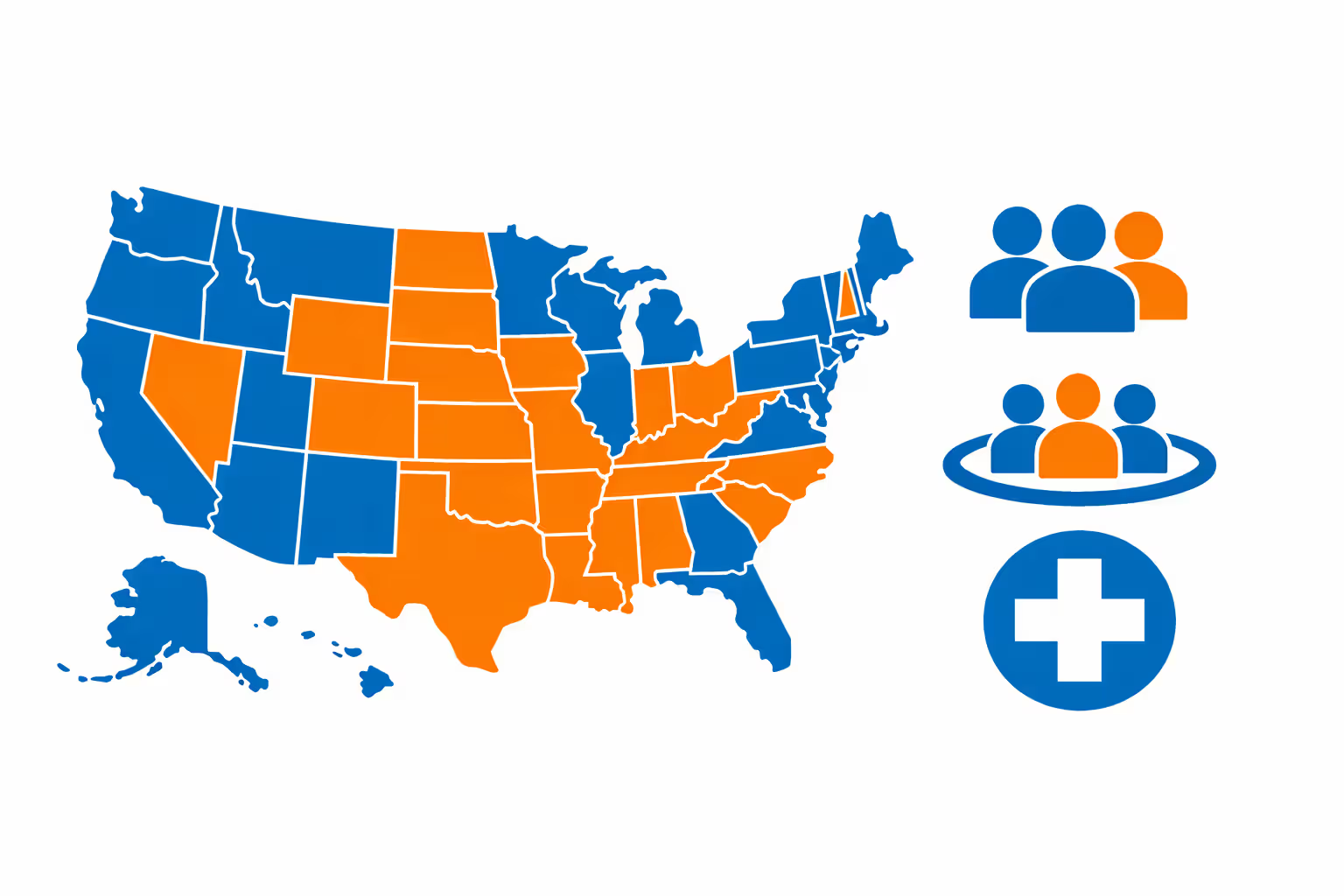
Medicaid expansion complicates the picture further. States that expanded their Medicaid programs under the ACA now cover adults making up to 138% of poverty level through Medicaid instead of marketplace plans. Forty states plus DC have expanded as of 2026. In the ten holdout states, childless adults often land in a coverage gap—they earn too much for traditional Medicaid (which only covers disabled people, pregnant women, and parents) but too little (under 100% FPL) to qualify for marketplace subsidies.
Author: Melissa Grant;
Source: blaverry.com
Key Milestones in the Obamacare Timeline
More than fifteen years of policy battles, court fights, and implementation challenges created the obamacare timeline:
March 23, 2010: Obama signs the legislation. Some provisions activate immediately—like letting young adults stay on parent's coverage until age 26 and banning lifetime benefit caps.
June 28, 2012: Supreme Court upholds the law's constitutionality in NFIB v. Sebelius. However, the Court rules Congress can't force states to expand Medicaid, making expansion voluntary instead of mandatory.
October 1, 2013: The federal marketplace website launches and promptly crashes. Technical disasters plague the first enrollment period. News coverage focuses on the website failures rather than the millions who eventually enroll despite the problems.
2014: Major coverage rules kick in. Insurers lose the ability to reject applicants or charge higher premiums based on health history. Medicaid expansion goes live in participating states. The individual mandate penalty begins—people without coverage owe money at tax time.
2015-2016: The marketplace stabilizes somewhat. Enrollment climbs past 12 million. Several insurance co-ops created by the law collapse financially. Some major insurers exit specific markets, claiming they're losing money on ACA plans.
December 2017: Tax reform legislation zeroes out the individual mandate penalty starting in 2019. The coverage requirement technically remains law, but there's no financial consequence for ignoring it at the federal level.
June 17, 2021: Supreme Court dismisses yet another attempt to overturn the ACA in California v. Texas, leaving the law standing.
2021-2023: American Rescue Plan and Inflation Reduction Act pump up subsidies substantially. Middle-income families suddenly find marketplace coverage affordable. The "subsidy cliff" at 400% FPL disappears temporarily.
2026: Enhanced subsidies continue through 2027. Enrollment hits approximately 21 million people across federal and state marketplaces—the highest number in the program's history.
Common Questions About Obamacare
Shopping for health insurance through the marketplace means juggling monthly costs against potential medical expenses, understanding how subsidies shift when your income changes, and recognizing the trade-offs each plan type creates. The system has real flaws—coverage gaps persist in non-expansion states, doctor networks can be frustratingly narrow, and reconciling tax credits complicates your April tax filing.
Still, 21 million Americans enrolled in 2026 found marketplace coverage gave them access to comprehensive insurance they couldn't otherwise afford or obtain. Someone with rheumatoid arthritis no longer faces rejection letters or $2,000 monthly premiums. A family of four earning $80,000 can access subsidized coverage instead of gambling on staying healthy. A 60-year-old who lost their job has a bridge to Medicare that won't drain their 401(k).
Start by calculating your household's estimated MAGI for the year—include self-employment profits, investment earnings, taxable Social Security, and other income streams. Compare that figure to federal poverty guidelines for your household size to estimate subsidy eligibility. During Open Enrollment or following a qualifying event, examine plans across all metal tiers. Focus on total costs—premiums plus deductibles plus out-of-pocket maximums—not just that monthly bill. Earning under 250% of poverty? Prioritize Silver plans to unlock cost-sharing reductions.
The marketplace isn't everyone's best option. People with affordable employer coverage usually come out ahead sticking with their job-based plan. Seniors transition to Medicare at 65. But for individuals and families buying their own insurance, grasping how Obamacare operates transforms an overwhelming bureaucratic maze into a manageable path toward financial protection and healthcare access.