

Person sitting at kitchen table looking at health insurance termination letter with insurance card and coffee mug nearby
COBRA Health Insurance Explained

Content
Your last day at work just passed, and suddenly you're staring at a benefits termination letter. Maybe you got laid off. Maybe you quit. Either way, your health insurance—the coverage you've relied on for years—is about to disappear. Now what?
You've probably heard coworkers mention COBRA in hushed break room conversations. "It's so expensive," someone always says. "But it saved me when I needed surgery between jobs," another person counters. The truth? COBRA isn't simple, cheap, or right for everyone. But understanding it could mean the difference between continuous coverage and a terrifying gap when you need care most.
What Is COBRA and How Does It Work?
Back in 1985, Congress created the Consolidated Omnibus Budget Reconciliation Act—mercifully shortened to COBRA—to solve a specific problem: people losing health coverage overnight when they left their jobs. The law essentially forces most group health plans to let former employees stick around temporarily, even after employment ends.
Here's what's happening behind the scenes. Your employer doesn't actually create your health insurance—they contract with an insurance company (think Blue Cross, Aetna, UnitedHealthcare) to cover all employees as one big group. COBRA doesn't give you different insurance. You're keeping your exact existing plan. Same insurance card. Same prescription drug list. Same doctor network. Same everything.
Your employer's benefits administrator—sometimes the HR person you know, sometimes an outside company that specializes in this paperwork—manages the process. They handle your enrollment forms and collect your monthly checks. The insurance company often doesn't even know your employment status changed.

Author: Ethan Bradford;
Source: blaverry.com
The catch? You're now paying what your employer previously paid plus what you contributed as an employee, plus a small administrative charge. When you worked there, your employer probably covered 70-80% of the premium. Now that's entirely on you.
Who has to offer COBRA? Private companies with 20+ employees must comply, calculated using a weird formula counting full-time workers as one and part-timers as fractions. State and local government workers get similar protections. Federal employees follow different rules entirely. If your company employs 15 people, federal COBRA doesn't apply—though your state might have its own "mini-COBRA" law with shorter coverage periods.
What causes COBRA eligibility to kick in? Job termination works, unless you committed gross misconduct (think embezzlement or threatening violence, not showing up late). Hour reductions that drop you below eligibility thresholds qualify too. Divorce from the covered employee triggers it. So does the death of the employee, a dependent child aging out of coverage, or the working spouse enrolling in Medicare.
Each triggering situation determines how long you can keep coverage and who exactly gets continuation rights. Lose your job? Eighteen months. Get divorced from someone whose plan covered you? Thirty-six months. The rules get intricate fast.
The real advantage here isn't the price—it's continuity. If you're six months into treatment for a serious condition, switching insurance plans means new prior authorizations, potentially different medications, possibly even new specialists. When your gastroenterologist finally figured out the right medication combination after two years of trial and error, do you really want to start over with someone new who's not in your new plan's network?
Who Qualifies for COBRA Coverage?
Three requirements must line up before you can elect COBRA: your employer must be the right size, you must have the right relationship to the health plan, and the right type of triggering event must occur.
Start with employer size. The 20-employee threshold counts workers, not hours. A company with fifteen full-timers and ten half-time employees hits the threshold (15 + 5 = 20 in COBRA math). This count must hold true for more than half of typical business days in the prior calendar year. One exception: if your small-employer state has mini-COBRA laws extending rights to companies with 2-19 employees, you might still have options, though the coverage period is usually shorter.
You personally must have been enrolled in the group health plan the day before the qualifying event occurred. Waived coverage to save money? You're out of luck now—you can't retroactively decide to elect COBRA for coverage you never had. The qualifying event must also directly cause your coverage loss. Quitting your job works. Your employer dropping health benefits for all employees doesn't trigger individual COBRA rights (though it might trigger a special enrollment period for marketplace plans).
Qualifying Events That Trigger COBRA
For employees, the list is fairly straightforward. Voluntary resignation qualifies you. So does being laid off, furloughed, or terminated for performance issues. Even getting fired for poor performance triggers COBRA—the "gross misconduct" exception is narrow and typically requires documentation of serious policy violations or illegal activity.
Hour reductions create qualification too, which catches people off guard. If your employer cuts you from 32 hours weekly to 25 hours, and company policy requires 30 hours for benefits eligibility, you've just experienced a qualifying event even though you're still employed.
Spouses covered under an employee's plan get broader triggering events. Everything that qualifies the employee also qualifies the spouse. But spouses also gain COBRA rights if they divorce or legally separate from the covered employee, if the employee dies, or when the employee becomes Medicare-eligible (which often terminates the spouse's coverage under the group plan).
Dependent children qualify under the same circumstances as spouses, plus one additional trigger: losing dependent status as defined by the plan terms. When your daughter turns 26 and ages out of coverage, that's her qualifying event. Some plans terminate dependent coverage when a child graduates college, gets married, or no longer lives with parents—these can all trigger COBRA rights for the child.
Covered Family Members Under COBRA
Here's something that surprises people: each qualified beneficiary makes independent elections. Your whole family doesn't have to move as a unit.
Let's say you lose your job, and you'd been covering yourself, your spouse, and two children under your employer plan. All four of you become qualified beneficiaries. You might elect COBRA while your spouse and kids choose a subsidized marketplace plan. Or everyone might elect COBRA except your adult daughter who just got hired somewhere with immediate benefits. Each person decides separately.
New family members can join during your COBRA period through the same rules that applied when you were employed. Have a baby while on COBRA? You can add that child to your continuation coverage. Marry someone during your COBRA period? They can be added as a dependent if plan rules allow it.
One critical distinction: when divorce or dependent aging-out triggers COBRA, only the person losing coverage gains continuation rights. If you divorce your spouse, they get COBRA rights to continue coverage previously provided through your employer plan. You don't get separate COBRA rights from that event—you were already eligible for coverage through your employment.
How Much Does COBRA Cost?
Brace yourself. This is where COBRA stops sounding attractive for most people.
You'll write a check each month for 102% of the total plan premium. That "total premium" is what the insurance company actually charges to cover you—the amount your employer paid plus what you contributed as an employee. The extra 2% covers administrative hassles your former employer faces managing COBRA enrollments.
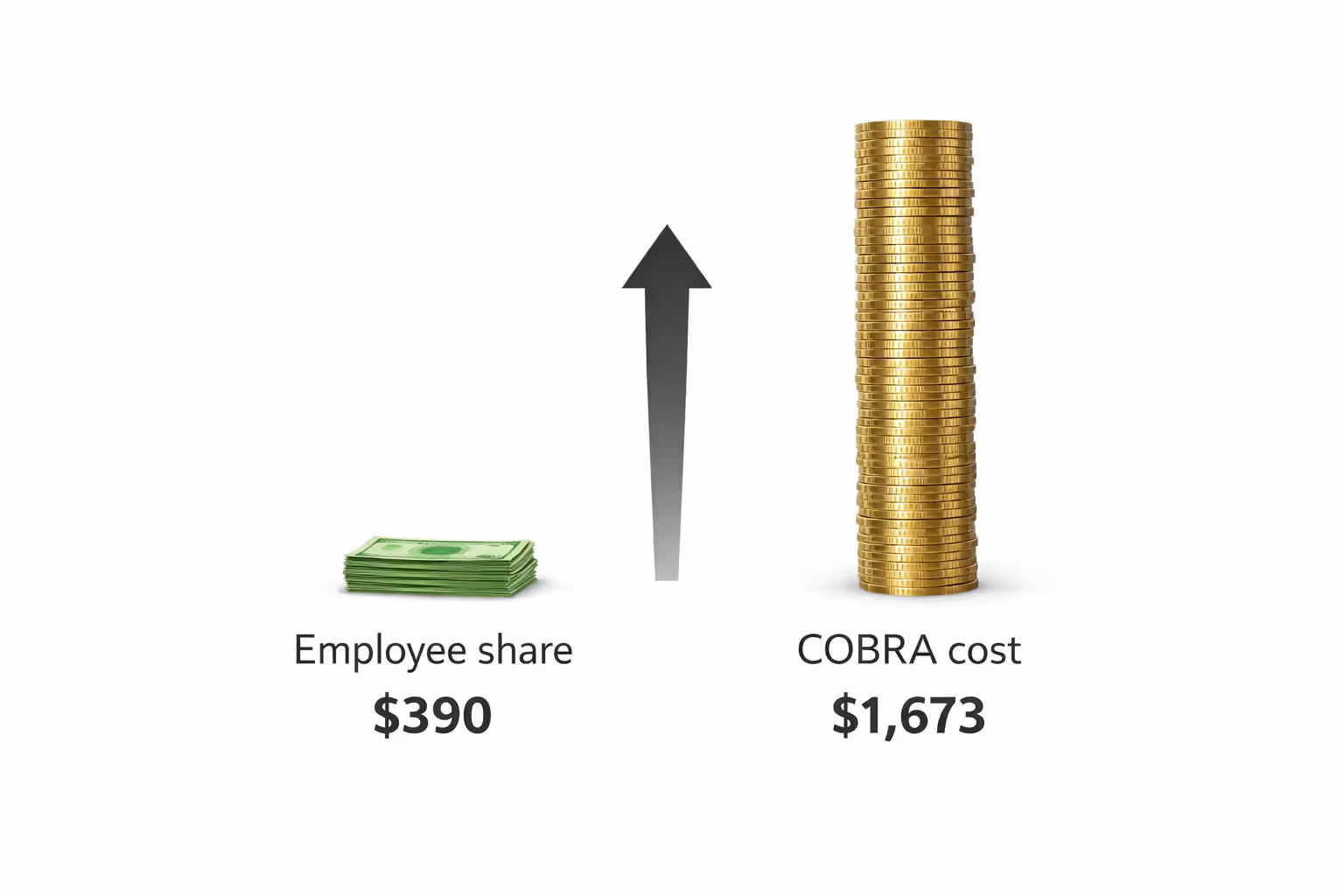
Real numbers help here. Imagine you worked at a mid-size manufacturing company. Your paycheck showed $180 deducted biweekly for family health coverage—$390 monthly. You probably thought, "Health insurance costs about $390."
Author: Ethan Bradford;
Source: blaverry.com
Wrong. Your employer was quietly contributing $1,250 monthly that never appeared on your paycheck. Total actual premium: $1,640. Your COBRA bill? $1,673 monthly ($1,640 × 1.02). That's 329% more than you're accustomed to paying.
For 2026, typical COBRA premiums run $650-$850 monthly for individual coverage in most markets. Family coverage frequently hits $1,900-$2,300 monthly. Live in Manhattan or San Francisco? Push those figures 25-40% higher. Work for a company with an unusually generous plan covering everything? Also higher.
Your age, health status, and claims history don't affect COBRA pricing—good news if you're dealing with expensive chronic conditions. You pay the same rate as active employees in your coverage category. A healthy 28-year-old and a 58-year-old with diabetes pay identical premiums if they're both electing single coverage under the same plan.
Premiums can still increase during your COBRA period, but only if rates increase for active employees too. Most group plans adjust rates annually, usually effective January 1st. If your employer's plan administrator sends notice that premiums are increasing 8% for everyone, your COBRA premium increases 8% too.
Some employers—particularly those conducting larger layoffs—voluntarily subsidize COBRA premiums for a few months as part of severance packages. This is negotiable and varies wildly. I've seen arrangements from "one month fully paid" to "six months at 50% cost" to generous packages covering 12+ months completely. Never hurts to ask during exit negotiations, especially if you're signing a severance agreement.
COBRA Enrollment Deadlines and Coverage Period
Miss these deadlines and you're done. No appeals. No extensions. No "I didn't understand" exceptions.
Here's the timeline: Your employer has 30 days from the qualifying event to notify the plan administrator (this might be the same entity). The administrator then has 14 days to mail your election notice—a thick packet explaining your rights, costs, coverage details, and election instructions.
From the date you receive that notice, or from the date your coverage ended (whichever comes later), you have exactly 60 days to elect COBRA. Not business days. Calendar days. If day 60 falls on Sunday, that's your deadline. The postmark date typically counts, but why risk it?
Once you elect coverage, the clock switches to a payment deadline: 45 days to remit your first premium payment. This payment must cover all months from your coverage loss date forward. If you lost coverage July 1st and elected COBRA on August 20th, your first payment (due by October 4th) covers July, August, September, and October—four months of premiums in one check.
This creates an interesting strategic option. You can wait during that 60-day election period to see whether you actually need medical care. No doctor visits, no prescriptions? You might decide not to elect COBRA and save thousands in premiums. But if your kid breaks an arm on day 45, you can still elect COBRA and pay retroactively to cover that emergency room bill. Risky? Absolutely. But it's legal and people do it.
After initial enrollment, monthly premiums typically come due on the first of each month. Most administrators provide a 30-day grace period, meaning your September premium might be due September 1st but not actually late until October 1st. Miss that grace period and your coverage terminates immediately—and permanently. You can't reinstate it by paying late.
Coverage duration depends entirely on your qualifying event type. Job loss or hour reduction provides 18 months of continuation. Divorce, legal separation, employee death, or dependent losing eligibility provides 36 months. If Social Security determines you were disabled when employment terminated (or within the first 60 days after), you might extend the 18-month period to 29 months, though premiums increase to 150% of the plan cost for months 19-29.
Multiple qualifying events can extend coverage further. Imagine you lose your job in March 2026 (starting an 18-month COBRA period ending August 2027). You divorce in January 2027 while on COBRA. Your ex-spouse's continuation coverage could now extend to March 2029—36 months from your original qualifying event in March 2026.
COBRA vs. Marketplace Insurance: Which Should You Choose?
This decision involves actual math, not just gut feelings. Pull out your calculator.
Marketplace plans—sold through Healthcare.gov or your state's exchange—often cost less after premium subsidies are applied, especially if job loss reduced your household income. COBRA never qualifies for subsidies, regardless of income. Never. A single person earning $30,000 annually might find marketplace plans costing $75-$150 monthly after subsidies, while COBRA for the same person might run $650 monthly. That's $7,000+ annual savings.
Job loss creates a Special Enrollment Period for marketplace coverage, giving you 60 days from coverage loss to enroll outside the normal November-December Open Enrollment window. This timing mirrors your COBRA election period, letting you compare both simultaneously.
| Feature | COBRA | Marketplace Plan |
| Monthly premium | Full premium plus 2% admin fee; often $650-$2,300 | Variable; subsidized rates available based on income, potentially $50-$400 |
| Subsidy eligibility | Never eligible for premium tax credits | Premium tax credits available for household incomes 100-400% of federal poverty level |
| Coverage start | Retroactive to date coverage ended | First of the month after enrollment or first of following month |
| Provider network | Identical to your previous employer plan | Different networks; requires checking if current doctors participate |
| Maximum duration | 18-36 months based on qualifying event | Continuous with annual renewals; no time limit |
| Ease of enrollment | Simple election form; no shopping required | Requires comparing plans and selecting new coverage |
When COBRA Makes Sense
You're seven months into treatment with an oncologist who's managing your lymphoma. Your treatment protocol is working. You've already paid $6,400 toward your $7,000 out-of-pocket maximum, meaning everything's now covered at 100% through December. Switching to a marketplace plan means finding a new oncologist who may not be in the new network, restarting prior authorizations for your medications, and resetting your deductible and out-of-pocket maximum to zero in the new plan.
COBRA makes perfect sense here, at least through year-end. You'll pay $2,800 for four months of COBRA (August-December), but you'll save the $7,000 out-of-pocket maximum you'd restart by switching plans. Come January when your COBRA deductible resets anyway? That's when you reevaluate marketplace options.
Short-term needs favor COBRA too. Starting a new job November 1st with benefits effective immediately? Paying $1,350 for two months of COBRA beats spending hours researching marketplace plans you'll barely use.
High earners who don't qualify for subsidies sometimes face similar pricing between COBRA and marketplace plans, especially in areas with limited marketplace competition. If COBRA costs $720 monthly and the comparable marketplace Silver plan costs $690, the $30 monthly savings might not justify changing doctor networks and dealing with enrollment hassles.
Complex specialty medication situations lean toward COBRA. If you're on a specialty drug that required extensive prior authorization battles, staying on COBRA preserves those approvals. Starting fresh with a marketplace plan means re-fighting those authorization battles with a new insurance company.

Author: Ethan Bradford;
Source: blaverry.com
When Marketplace Plans Are Better
Most people coming off employer coverage—especially those experiencing involuntary job loss with reduced income—save substantial money choosing subsidized marketplace coverage over COBRA.
Run the numbers. A family of three with 2026 household income projected at $55,000 qualifies for significant premium tax credits. A Silver plan that would cost $1,600 monthly at full price might cost this family $350 monthly after subsidies. Compare that to $2,100 monthly for family COBRA coverage, and you're saving $21,000 over twelve months.
Healthy individuals not currently in treatment can more easily switch provider networks. If you see your primary care doctor twice yearly for routine checkups and your kids are healthy, finding new in-network doctors in a marketplace plan is inconvenient but manageable. The thousands you save in premiums cover the hassle.
Marketplace plans offer flexibility COBRA can't match. Your employer chose the group health plan based on what worked for their employee population. Now you can choose based on your specific needs. Need better prescription coverage because you take expensive medications? Choose a plan with lower drug costs. Super healthy and want lower premiums? Pick a high-deductible plan paired with a Health Savings Account.
Long-term coverage needs favor marketplace plans simply because they don't expire. COBRA coverage terminates after 18-36 months regardless of your health situation or whether you've found new employment. Marketplace coverage continues indefinitely as long as you pay premiums.
Individual elections work in marketplace plans too. Your spouse might benefit from staying on COBRA temporarily to finish treatment with established specialists, while you and the kids enroll in a subsidized marketplace plan immediately. Each qualified beneficiary makes independent choices.
Common COBRA Mistakes to Avoid

Author: Ethan Bradford;
Source: blaverry.com
The most expensive mistake? Missing the 60-day election deadline because you thought you had "plenty of time" to decide. Day 60 arrives fast when you're dealing with job loss stress, updating your resume, and managing daily life. Mark the deadline on every calendar you own. Set three phone reminders. Tell your spouse. This deadline is absolute.
Electing COBRA but missing the 45-day first premium payment deadline wastes your election. You've committed to coverage but failed to pay for it, which terminates the coverage before it technically starts. Even worse, you've now used your 60-day election period, so you can't re-elect. If you elect COBRA, immediately budget for that large first payment covering all retroactive months.
Failing to compare marketplace alternatives before electing COBRA burns money. I've met people paying $1,800 monthly for COBRA when they would've qualified for subsidized marketplace coverage costing $200 monthly. "I didn't know I had options," they say later. You always have options. Spend two hours on Healthcare.gov entering your information and comparing costs before committing to COBRA.
Assuming COBRA coverage is identical to what you had as an employee sometimes proves wrong. Certain employer-sponsored perks don't continue. Your employer's $500 annual HSA contribution? Gone. The on-site clinic providing free basic care? No longer available—you're not an employee. FSA elections? Those typically terminate with employment. Read your election notice carefully to understand exactly what continues and what doesn't.
Not notifying plan administrators of secondary qualifying events costs you potential extended coverage. If you're on COBRA after job loss (18-month maximum), then divorce your spouse during that COBRA period, you must notify the administrator within 60 days. Your ex-spouse could then extend continuation up to 36 months total from your original qualifying event. Miss that notification deadline and the extension opportunity disappears.
Letting COBRA terminate without securing replacement coverage creates dangerous gaps. Once your 18-month COBRA period ends, you're done—no extensions, no re-elections. That termination doesn't trigger a Special Enrollment Period for marketplace plans unless it's already Open Enrollment season (November 1 - January 15). If your COBRA ends in June and you haven't secured other coverage, you're potentially uninsured until the next Open Enrollment. Plan ahead.
I've worked with hundreds of clients facing COBRA decisions over 15 years. The biggest misconception is that COBRA is always prohibitively expensive and should be dismissed immediately. I've seen cases where someone with $8,000 in deductibles already met would actually lose money by switching to marketplace coverage, even with subsidies. The key is calculating your specific situation—including your deductible progress, your provider networks, and your expected medical costs for the coverage period—rather than making assumptions based on sticker shock from the premium amount
— Jennifer Martinez
Frequently Asked Questions About COBRA
COBRA isn't inherently good or bad—it's a tool designed for specific situations. For someone six months into cancer treatment with an established oncology team, COBRA provides invaluable continuity despite high costs. For a healthy 32-year-old laid off from a marketing job with household income dropping below $40,000, subsidized marketplace coverage saves thousands over COBRA.
Your decision framework should include these calculations: total COBRA cost for your expected coverage period, comparable marketplace plan costs after subsidies, your current deductible and out-of-pocket maximum progress, your relationship with current providers, and whether those providers accept marketplace plan networks.
Don't decide based on premium sticker shock alone. A $1,800 monthly COBRA premium looks outrageous until you realize you've already met $5,200 of your $6,000 deductible in July, and switching to a marketplace plan resets that to zero. Paying $7,200 for four months of COBRA (August-December) saves the $6,000 deductible you'd restart in a new plan.
Use Healthcare.gov's actual calculator tools to get specific premium quotes with subsidies. Don't guess at what marketplace plans might cost—get exact numbers based on your household size and projected income. This takes 20 minutes and provides the critical data you need.
Call your current doctors, specialists, and preferred hospital to ask which marketplace plans they accept. This information affects your decision significantly. If your rheumatologist who finally got your autoimmune disease under control doesn't accept any marketplace plans in your area, that changes the math.
Remember that you can mix strategies. Stay on COBRA through December to preserve your deductible progress and relationship with current providers, then switch to marketplace coverage in January when deductibles reset anyway. Or cover yourself with COBRA for three months while you finish treatment, while your healthy spouse and kids immediately choose subsidized marketplace plans.
The 60-day election window exists to give you time for exactly this kind of analysis. Use it. Spending a few hours now researching options beats spending months paying unnecessarily high premiums—or worse, ending up uninsured when you need coverage most.
COBRA isn't the only option after losing employer coverage, but understanding how it works, what it costs, and when it makes sense keeps you covered during life transitions. Whether you ultimately elect COBRA or choose alternatives, making an informed decision beats making a rushed one every time.