

Diverse group of office employees sitting at a conference table reviewing health insurance documents with a medical shield symbol in the center
What Is Employer Sponsored Health Insurance

Content
When you accept a job offer, health benefits often rank just below salary in importance. Employer sponsored health insurance—coverage your company arranges and partially funds—operates differently from policies you'd buy directly from an insurance company. Your workplace negotiates with insurers, picks specific plans, and covers a chunk of the monthly bill. You chip in the rest through automatic deductions from your paycheck.
This system touches more American lives than any other insurance model. The Kaiser Family Foundation counts approximately 153 million people under age 65 who get their coverage this way. It's a win-win setup: companies use health benefits to compete for talent while scoring tax advantages, and workers access discounted group rates that beat shopping solo on the individual market.
Mastering the mechanics—from eligibility rules to cost structures to strategic enrollment timing—can slash your annual healthcare spending by thousands while keeping you continuously covered.
How Employer Sponsored Health Insurance Works
Your company's HR department starts by contracting with insurance carriers who agree to cover all participating employees as one large group. This pooling mechanism delivers lower per-person pricing because insurers spread financial risk across hundreds or thousands of workers. The 28-year-old marathon runner essentially cross-subsidizes the 54-year-old managing multiple prescriptions.
During your benefits orientation, you'll review somewhere between two and four plan choices. Maybe there's a high-deductible option paired with a health savings account, a PPO that lets you visit almost any doctor without referrals, and an HMO requiring you to pick a primary care physician who coordinates everything. Each carries different premium costs, deductibles, and network restrictions. You compare the numbers against your family's medical needs and pick one.
Your premium contribution vanishes from each paycheck before taxes touch it, thanks to Section 125 cafeteria plan rules. Let's say your share runs $180 monthly and you're paid twice per month. You'll see $90 deducted every payday—money the IRS never counts as taxable income. Your employer bundles your contribution with theirs and sends the full amount to the insurance company, activating your coverage.
When you visit the doctor, the billing cycle works like any insurance claim. The provider submits charges to your insurer. The insurance company checks your deductible status, applies coinsurance percentages, then cuts a check to the doctor. You receive an explanation of benefits showing what got covered and what you owe. This pattern repeats throughout your plan year, often January through December, though some companies run different schedules.
Here's where people stumble: assuming coverage kicks in the moment they're hired. Most plans impose waiting requirements, and if you miss your enrollment opportunity, you might go months without insurance.
Who Qualifies for Employer Sponsored Coverage
Your work schedule determines eligibility more than anything else. The Affordable Care Act forces companies with 50+ full-time equivalent workers to extend offers to anyone averaging 30 weekly hours or more. Smaller outfits face no such requirement but might offer plans anyway to stay competitive when hiring.
Full-timers almost universally qualify, though each company defines "full-time" slightly differently. One might draw the line at 32 hours weekly while another insists on 35. Part-time staff rarely qualify unless state regulations or union agreements force inclusion. Seasonal workers typically remain ineligible unless they stick around longer than a predetermined period.
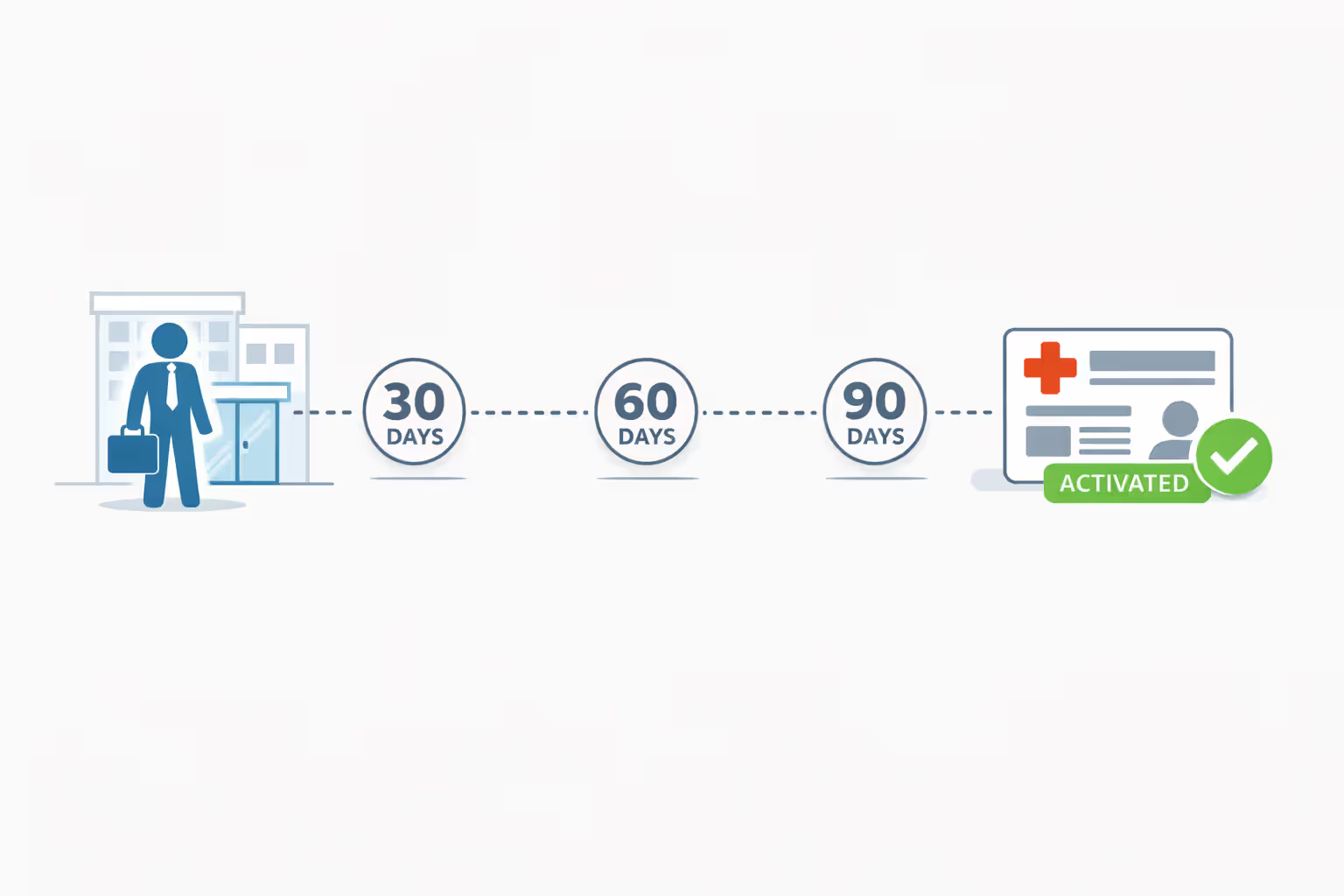
Fresh hires usually wait before coverage activates. Federal law caps this delay at 90 days, but plenty of companies start coverage on the first day of the following month after you've completed 30 or 60 days of work. Imagine starting March 15 at a company with a 60-day waiting period and first-of-month effective dates. You wouldn't get covered until June 1—nearly 11 weeks out. Understanding this gap helps you avoid unexpected medical bills during your transition.
Author: Lauren Prescott;
Source: blaverry.com
Waiting Periods and Enrollment Windows
That 90-day maximum protects new employees from endless delays without forcing instant coverage. Companies balance paperwork efficiency against employee satisfaction. Shorter waits attract better candidates; longer waits cut costs when turnover runs high.
Your annual open enrollment window typically opens once yearly, usually fall months leading to January 1 start dates. This two-to-four-week period represents your only chance to join, switch plans, or add family members—unless something major happens in your life. Marriage, having a baby, adopting a child, losing coverage elsewhere, or experiencing significant income shifts all create special enrollment opportunities. You get 30 to 60 days to act, depending on which event occurred.
There's no forgiveness for missing open enrollment. Say you skipped enrollment planning to stay on your spouse's policy, then that coverage unexpectedly ends in March. The loss qualifies you for special enrollment. But if you simply forgot to complete the forms? You're stuck waiting until next fall unless your employer shows unusual mercy.
Dependent and Spouse Coverage Rules
Most employer plans extend to spouses and children up to age 26, regardless of whether your adult child attends school, got married, or earns their own income. The Affordable Care Act established this protection, rescuing millions of young adults from coverage gaps.
Adding family members drives premiums up substantially. Your solo coverage might run $150 monthly while employee-plus-spouse jumps to $420 and full family coverage hits $650. Employers commonly pay a fixed percentage of the employee-only rate—maybe 80 percent—but contribute proportionally less toward dependent coverage, sticking you with more of the family bill.
Domestic partners qualify under certain plans, especially in states recognizing these relationships legally. Some insurers want proof you share an address and split financial responsibilities, while others accept a simple signed statement. Tax treatment gets tricky though; your domestic partner's coverage might count as taxable income unless they qualify as your tax dependent under IRS rules.
When both spouses carry employer coverage, coordination of benefits rules determine which insurer pays first. For kids, the "birthday rule" applies: whichever parent's birthday comes earlier in the calendar year holds the primary plan. For the spouses covering each other, each person's employer plan pays primary on their own claims.
What Employer Sponsored Health Insurance Covers
Federal law mandates that group health plans include ten essential benefit categories: ambulatory patient services, emergency care, hospital stays, pregnancy and newborn services, mental health and addiction treatment, prescriptions, rehabilitative services and devices, lab work, preventive and wellness services, and pediatric care including oral and vision.
Preventive services come free—no copays, no deductibles when you stick with in-network providers. Your annual physical, vaccinations, cancer screenings, and blood pressure monitoring cost nothing out-of-pocket. This design catches health problems early before they balloon into expensive crises.
The medical portion tackles your biggest expenses: physician visits, surgical procedures, MRIs and CT scans, physical therapy, wheelchairs and hospital beds. Network boundaries matter enormously. PPO arrangements let you venture outside the network for higher cost-sharing, while HMO structures generally refuse payment for out-of-network care unless you're facing a true emergency. Narrow network designs, growing more common lately, restrict your choices even further in exchange for reduced premiums.
Prescription coverage operates through tiered formularies that dictate your out-of-pocket costs. Generic drugs land in tier one with minimal copays—typically $10 to $15. Preferred brand-name medications occupy tier two around $40 to $60. Non-preferred brands cost $80 to $120 in tier three. Specialty drugs for conditions like cancer or multiple sclerosis hit tier four, sometimes demanding 20 to 30 percent coinsurance that reaches $500+ monthly until you exhaust your out-of-pocket maximum.
Dental and vision benefits usually require separate elections with additional monthly charges. Standard dental plans cover two cleanings yearly, X-rays, and cavity fillings at 80 to 100 percent after a small deductible. Major procedures like crowns or root canals drop to 50 percent reimbursement. Vision plans typically include one annual eye exam plus $150 to $200 toward glasses or contact lenses every 12 to 24 months.
Your coverage period spans the plan year, resetting deductibles and out-of-pocket limits when the calendar flips. If you're running a January-to-December plan year and you've already satisfied your $3,000 deductible by November, that progress evaporates on New Year's Day. Smart patients schedule elective surgeries near year-end after meeting their cost-sharing requirements.

Author: Lauren Prescott;
Source: blaverry.com
How Much Employer Sponsored Health Insurance Costs
The premium bill divides between your employer and you, with companies picking up an average 83 percent for individual coverage and 73 percent for families based on 2026 benchmarks. An employee-only plan costing $650 monthly might require $110 from your paycheck, while a $1,900 family plan could demand $515 in employee contributions.
These numbers swing wildly across industries, company sizes, and locations. Silicon Valley tech firms competing for engineers often cover 90 to 100 percent of individual premiums. Small retail businesses running thin margins might cover barely 60 percent. Union contracts frequently lock in specific contribution formulas.
Your deductible represents what you pay before insurance starts sharing costs. High-deductible health plans begin at $1,600 for singles and $3,200 for families in 2026, with many pushing to $3,000 and $6,000. Traditional plans might feature $500 to $1,500 deductibles. Lower deductibles mean higher premiums—you're choosing between predictable monthly payments and upfront financial risk.
Copays hit you for specific services: $25 for your primary doctor, $50 for specialists, $100 for urgent care clinics, $350 for emergency rooms. These flat fees create predictability but accumulate quickly when you're managing chronic conditions.
Coinsurance activates once you've cleared your deductible, making you responsible for a percentage of costs—usually 20 percent—until you max out your annual limit. A $15,000 surgery generates $3,000 in coinsurance at that 20 percent rate. Stack that on top of your deductible and you're looking at $5,000 to $6,000 total for a single medical event.
Out-of-pocket maximums cap your yearly spending at $9,450 for individuals and $18,900 for families in 2026 under federal ceilings, though many plans set friendlier thresholds. Hit this ceiling and your plan covers 100 percent of everything else through year-end. This protection prevents medical debt from destroying your finances, though your premiums don't count toward this maximum.
Health savings accounts work exclusively with high-deductible plans, accepting pre-tax contributions up to $4,300 for singles and $8,550 for families in 2026. Many employers deposit $500 to $1,500 annually into these accounts. Unused money rolls over forever and can be invested, building a powerful tax-advantaged medical nest egg.
Employer Plans vs Marketplace Insurance
Deciding between workplace coverage and marketplace insurance means weighing costs, provider networks, subsidy eligibility, and flexibility. This choice typically surfaces when your employer's premium seems steep or the plan feels inadequate.
Employer Coverage vs Marketplace Plans: Side-by-Side
| Feature | Employer Coverage | Marketplace Plans |
| Monthly premium (your portion) | $110–$180 for singles | $450–$650 for singles before any subsidies |
| Subsidy eligibility | Blocked if employer meets minimum standards | Available when employer plan costs too much or you opt out |
| Number of plan choices | 2–4 options your employer picked | 40–60 options spanning bronze, silver, gold, platinum |
| When coverage begins | Month after waiting period; strict enrollment windows | Month following enrollment; more flexible special periods |
| Job portability | Terminates when you leave job | Continues through job transitions |
Cost differences usually control the decision. Workplace plans tap into group buying power and employer subsidies to dramatically reduce your net premium. A worker paying $150 monthly through their employer would face $550 monthly for comparable marketplace silver-tier coverage before subsidies kick in. Even with tax credits factored in, the marketplace frequently costs more unless your employer's plan fails the affordability test.
Affordability carries a precise technical meaning: when your employee-only premium exceeds 9.02 percent of household income in 2026, regulators consider the plan unaffordable, opening the door to marketplace subsidies. Someone earning $45,000 annually hits the affordability threshold at $338 monthly. If their employer charges $360 for solo coverage, they can refuse it and pursue subsidized marketplace alternatives. This calculation frustratingly ignores family coverage expenses—the notorious "family glitch" that continues despite recent attempts to patch it.
Network size varies considerably. Large employers negotiate extensive networks with major insurers. Smaller employers might choose restrictive networks to manage costs, limiting which doctors you can visit. Marketplace plans span the spectrum from narrow HMOs to expansive PPOs, giving you more control over the coverage-versus-cost equation.
Portability matters when you anticipate job changes. Marketplace coverage rolls along uninterrupted when you switch employers, while workplace plans die with your final work day. COBRA lets you extend employer coverage for 18 months by covering the full premium plus a 2 percent administrative charge, but this typically runs $600 to $2,000 monthly—often exceeding marketplace rates.
Your personal situation dictates the smart move. Healthy people with reasonable employer premiums rarely benefit from marketplace shopping. Those facing expensive employer contributions, needing specific providers, or experiencing income fluctuations should crunch both scenarios carefully. Families staring at high dependent premiums sometimes discover marketplace coverage costs less, particularly when subsidies enter the picture.
Enrollment Deadlines and Special Circumstances

Author: Lauren Prescott;
Source: blaverry.com
Open enrollment schedules vary by employer but usually span six to eight weeks during fall. Major corporations typically run enrollment through October and November for January 1 activation. Smaller companies might synchronize with their fiscal calendars, creating mid-year start dates.
Skip open enrollment and you're locked out until the next cycle unless life throws you a major curveball. These qualifying events unlock special enrollment windows lasting 30 to 60 days:
- Getting married or divorced
- Having or adopting a baby
- Losing other health coverage (job termination, aging off parents' plan, losing Medicaid)
- Major income changes affecting subsidy calculations
- Relocating permanently to new coverage regions
- Court orders mandating dependent coverage
You can't just claim a qualifying event without proof. Marriage licenses, birth certificates, coverage termination letters, and similar documentation must be submitted within strict timeframes. Employers verify these documents before permitting mid-year enrollment adjustments.
Premium payment grace periods offer brief protection against immediate cancellation. Most plans grant 30 days past the due date before terminating coverage, though you still owe the overdue premium. After cancellation, getting back in requires waiting until next open enrollment or experiencing a qualifying event.
COBRA continuation coverage creates a safety net when employment ends. Former workers can maintain their group plan for 18 months (29 months when disability is involved) by covering the entire premium plus administrative fees. This works well for brief coverage gaps or when pre-existing conditions make marketplace shopping expensive, but the costs prove unsustainable for most families long-term.
Consider this scenario: You're covered through your workplace plan when your spouse loses their job in August. They qualify for special enrollment on your plan, but you must alert HR within 30 days of their coverage loss. Wait 35 days? They're locked out until next January—potentially seven months uninsured. Calendar those qualifying events and respond immediately.
Expert Perspective:
The employer-based insurance model delivers exceptional value for healthy workers in stable jobs, but creates serious vulnerability for everyone else.Tying coverage to employment means job transitions generate dangerous gaps. COBRA's safety net prices most families out of the market long-term. More employers now offer voluntary and supplemental benefits to address these gaps, but the underlying structure still leaves millions exposed during major life changes. My advice? Anyone depending on workplace coverage should maintain an emergency fund dedicated specifically to covering potential gaps—at minimum three months of COBRA premiums or marketplace insurance costs
— Jennifer Martinez
Common Questions About Employer Health Coverage
Workplace health benefits remain how most working-age Americans access medical care, delivering group pricing and shared premium costs that make comprehensive coverage affordable. Mastering eligibility requirements, enrollment windows, cost-sharing mechanics, and the workplace-versus-marketplace decision empowers you to maximize value and dodge expensive mistakes.
Success requires paying attention. Missing a 30-day special enrollment window can strand you without coverage for months. Selecting the wrong plan tier can waste thousands in unnecessary premiums or surprise out-of-pocket charges. Failing to coordinate benefits properly when both spouses carry coverage generates claim rejections and administrative nightmares.
Scrutinize your options thoroughly during every open enrollment cycle. Calculate total annual costs including premiums, deductibles, and anticipated out-of-pocket spending based on your family's medical patterns. Compare your employer's subsidy against marketplace tax credit eligibility if premiums seem unreasonable. Explore HSA contributions when choosing high-deductible plans. Document qualifying life events the moment they occur and notify HR within mandatory windows.
The complexity frustrates plenty of people, but what's at stake—financial stability and accessing necessary medical care—justifies the investment of time. Workplace coverage, when you leverage it strategically, delivers robust protection at a fraction of individual market pricing. Understand your plan's mechanics thoroughly, and you'll navigate the system successfully while safeguarding both your health and your wallet.