

Close-up of a pay stub with highlighted health insurance deduction line next to a health insurance card and calculator on an office desk
How Much Do Employers Pay for Health Insurance

Content
Look at your latest pay stub. See that health insurance deduction? Maybe it's $125, perhaps $200. Here's what most people don't realize: that number you're paying represents roughly 15-30% of your actual health insurance premium. Your employer quietly picks up the rest—often $500 to $1,500 monthly that never appears on your paycheck.
Most working Americans get health coverage through their jobs. Companies spent over $800 billion on employee health benefits last year. Yet few employees understand the true dollar amounts flowing into their health coverage, or why their coworker at a different company might have wildly different premium costs for similar coverage.
Right now, the typical company covers about 82% of premiums when you insure just yourself. Add your spouse and kids? That employer share usually drops to 72%. But these figures shift dramatically based on where you work, which industry you're in, and whether your employer has 10 people or 10,000.
Average Employer Contributions by Plan Type
Your plan type—PPO, HMO, or high-deductible—changes both your total premium and how much your company absorbs. Insurers price these plans differently, and smart employers adjust what they'll cover based on the plan's structure.
Take PPO plans in 2026. For individual coverage, companies kick in roughly $7,200 yearly. That's 81% of the premium. The remaining $1,700 comes from your paycheck.
HDHPs cost less overall. Your employer might contribute $6,500 annually—84% of the premium. You're responsible for about $1,150. The tradeoff? You'll face higher deductibles before coverage kicks in, though many companies sweeten the deal with HSA contributions.
HMO plans land in the middle. Expect employer contributions around $6,800 per year, covering 83% of costs. Your portion runs approximately $1,400 annually.
Family coverage tells a different story. Total premiums triple or quadruple, and most employers won't cover the same percentage they do for individual plans.
For PPO family plans, companies contribute about $16,200 yearly—71% of the premium. You're covering $6,600 through payroll deductions. That's $550 monthly from your paycheck.
HDHP family coverage? Employer contributions average $14,800 (73% of the premium). Your share: roughly $5,500 annually.
HMO family plans typically see $15,400 in employer contributions, representing 72% of the total premium. Employees pay the remaining $6,000.
| Plan Type | Single Coverage Employer Contribution | Single Coverage % | Family Coverage Employer Contribution | Family Coverage % |
| PPO | $7,200/year | 81% | $16,200/year | 71% |
| HDHP | $6,500/year | 84% | $14,800/year | 73% |
| HMO | $6,800/year | 83% | $15,400/year | 72% |
These are national averages. Some tech companies cover 100% of employee premiums. Meanwhile, certain small businesses might only contribute 50% because that's all their budget allows.
What Determines How Much Employers Pay
Why does your friend's employer cover 90% of premiums while yours only covers 70%? Several factors drive these decisions, and they're rarely about generosity alone.
Company profitability matters most. A software firm generating 40% profit margins can afford richer benefits than a restaurant operating on 5% margins. Startups burning through venture capital often offer minimal contributions until they reach profitability.
Healthcare costs in your area play a huge role. Boston employers face premiums 30-40% higher than employers in Atlanta. Rather than contributing vastly different dollar amounts, many companies maintain consistent percentage contributions across locations, which means employees in expensive markets shoulder more absolute dollars.
Benefits philosophy varies by company culture. Some view health insurance as a recruiting weapon. Others see it as a necessary checkbox. That philosophical difference shows up in contribution levels.
Health insurance is the most important benefit an employer can offer. It's not just a line item on a budget — it's the foundation of a company's ability to attract and retain talent
— Drew Altman
Company Size and Contribution Rates
Company size predicts employer generosity more reliably than almost any other factor. Size brings negotiating leverage, predictable risk pools, and economies of scale in administration.
Businesses with fewer than 50 workers aren't legally required to offer health insurance at all. When they do, they typically contribute 68% toward individual coverage and just 52% toward family plans. Why so low? They're paying higher per-employee premiums due to limited negotiating power, and many operate with tight cash flow.
Mid-sized operations (50-199 employees) must offer coverage under federal law. They contribute around 78% for individual coverage and 65% for family plans. These companies face compliance costs without the purchasing power of larger competitors.
Large employers (200+ workers) offer the best contributions: 84% for individual coverage and 75% for family plans. Many Fortune 500 companies cover 90-100% of employee-only premiums. They've got dedicated benefits teams, can self-insure to reduce costs, and compete aggressively for talent.
Industry Variations in Coverage Costs
Your industry determines a lot about your health benefits. Tech companies and financial services firms routinely cover 85-95% of premiums. They're fighting for specialized talent in competitive markets. Health insurance becomes a battlefield in the war for engineers, analysts, and developers.
Retail and hospitality employers usually contribute 60-70% of individual premiums. High turnover makes generous benefits less effective as retention tools. Thin margins limit what they can spend. Many employees work part-time and don't qualify for coverage anyway.
Manufacturing plants, particularly unionized facilities, often feature negotiated contribution rates locked into collective bargaining agreements. Some contracts guarantee 100% employer-paid coverage for workers and dependents—though these "Cadillac plans" have become rare as costs have exploded.
Professional services—law firms, accounting practices, consulting companies—typically land in the 80-90% contribution range. They're courting highly educated professionals who scrutinize total compensation packages.

Author: Derek Whitmore;
Source: blaverry.com
Employee vs. Employer Cost Breakdown
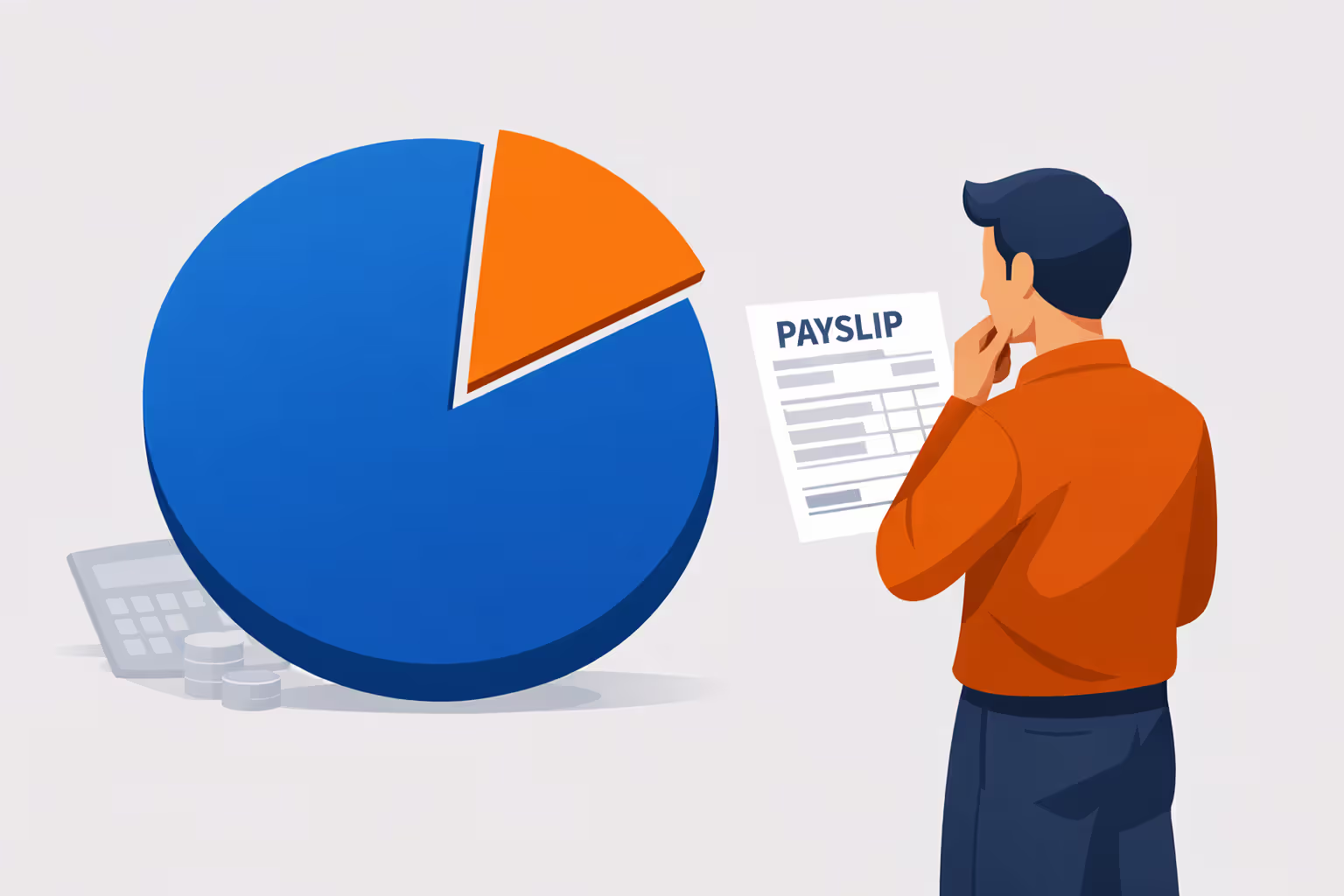
Let's break down who actually pays what. For individual coverage in 2026, you're probably seeing $125-$150 deducted from your paycheck monthly. That's $1,500-$1,800 yearly, representing roughly 17-20% of your true premium. Your employer silently covers the other $7,000-$7,500.
At least that deduction happens pre-tax. Through a Section 125 cafeteria plan, your contribution comes out before income tax, Social Security tax, and Medicare tax calculation. On a $60,000 salary, that pre-tax treatment saves you roughly $400-$500 annually versus paying with after-tax dollars.
Family coverage hits harder. Expect $450-$550 monthly in payroll deductions—$5,400-$6,600 yearly. That represents 28-30% of your actual premium. Your employer contributes the remaining $15,000-$17,000.
Notice the pattern? Employers subsidize your individual coverage more generously than dependent coverage. They're getting you covered at high levels. Your family members receive a smaller subsidy percentage, though the absolute dollar amount is higher.
Cost-sharing extends beyond premiums. Your PPO plan might carry an $1,800 individual deductible. Family deductible? Often $3,600-$4,000. Then come copays: $30 for primary care, $60 for specialists, $150 for ER visits. Add coinsurance—you pay 20% after the deductible. These out-of-pocket costs easily reach $3,000-$5,000 annually for families using healthcare regularly.
HDHPs push deductibles higher—$2,000-$3,000 for individuals, $4,000-$6,000 for families. Many employers offset this with HSA contributions of $500-$1,500 annually. That's additional compensation that doesn't appear as salary but reduces your healthcare costs.
Some progressive employers have adopted income-based contribution tiers. Employees earning under $50,000 might pay $50 monthly for coverage. Those making $150,000+ might pay $300 monthly for identical coverage. This approach spreads healthcare costs more equitably across income levels while managing the company's total benefits budget.
Author: Derek Whitmore;
Source: blaverry.com
Employer Coverage Eligibility Requirements
You can't just walk into a job Monday morning and have health insurance. Companies establish eligibility rules determining who qualifies and when coverage starts. These requirements dramatically affect when employer contributions begin flowing your way.
Full-time status serves as the gatekeeper. The Affordable Care Act defines full-time as 30+ hours weekly (or 130 hours monthly). Many companies set their own, stricter definitions—35 or 40 hours weekly. Work 28 hours? You're probably out of luck for benefits, regardless of how desperately you need coverage.
Waiting periods add another hurdle. Federal law allows companies to make new hires wait up to 90 days before coverage begins. Many employers impose 60-day waiting periods. Some use first-of-the-month rules: start January 15th, wait until March 1st for coverage. That gap leaves you scrambling for coverage options, potentially burning through COBRA from your old job or gambling without insurance.
Why do waiting periods exist? Companies want to avoid paying premiums for employees who quit during those first chaotic weeks. Early turnover runs 20-30% in some industries. Insurers also prefer not adding and removing people constantly.
The employer mandate works differently than most people think. Companies with 50+ full-time equivalent workers must offer "affordable" coverage to 95% of full-time employees and their children (not spouses). "Affordable" means your share of individual coverage can't exceed 9.12% of your household income in 2026. That percentage adjusts annually for inflation.
Miss your enrollment deadline? You're stuck waiting until next year's open enrollment unless you experience a qualifying life event. New hires typically get 30 days from eligibility to enroll. Blow past day 30, and you're looking at a 12-month wait. No exceptions.
How Employer Plans Compare to Marketplace Insurance
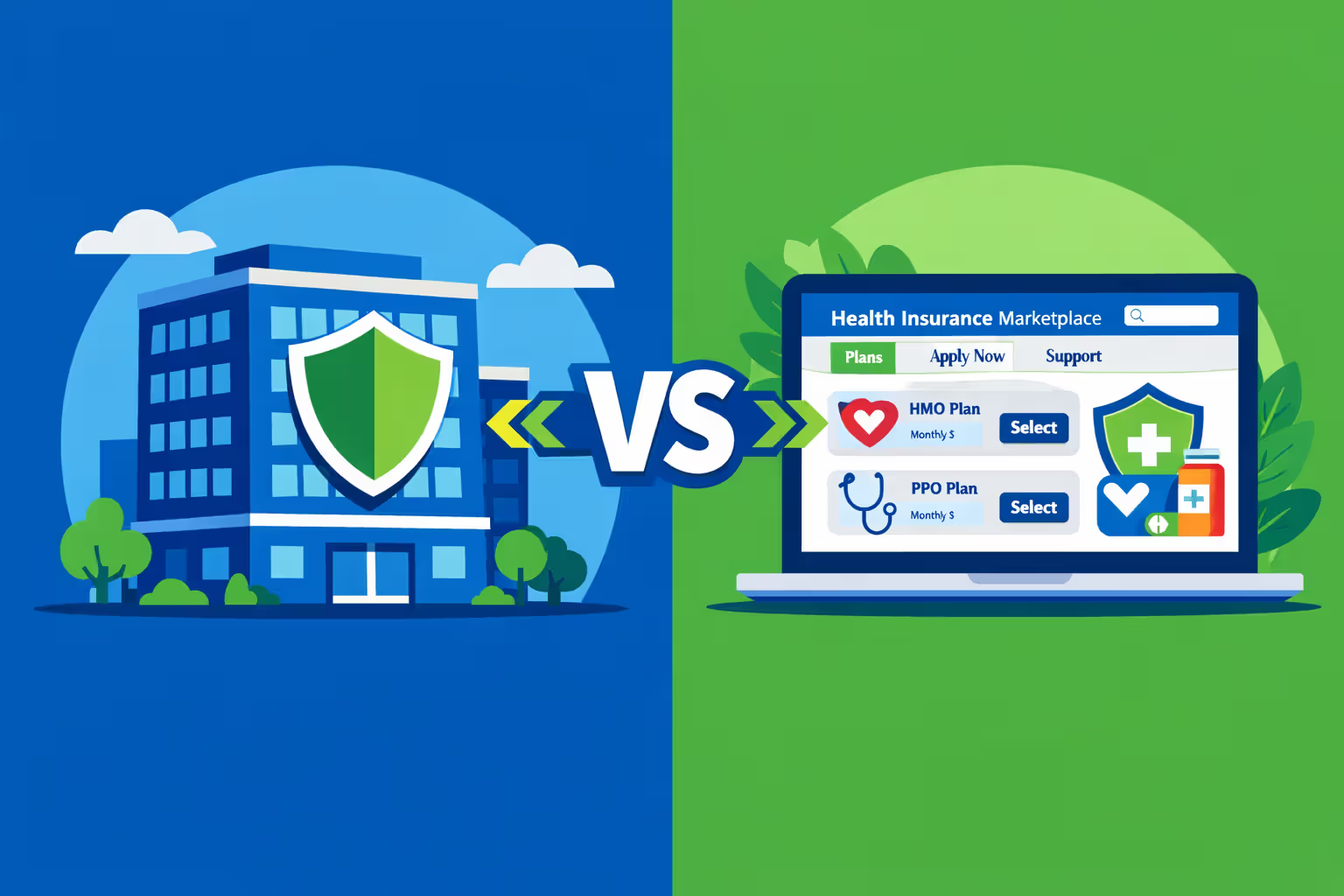
Should you ever skip your employer's plan and buy marketplace coverage instead? For 85% of people, employer coverage wins. But let's examine the scenarios where marketplace plans make sense.
Employer plans almost always cost less from your paycheck than marketplace coverage of similar quality. Your employer's contribution represents tax-free compensation—you're not paying income tax on that $7,000 or $15,000 annual benefit. That's a massive advantage.
Marketplace premium tax credits change the calculation. These subsidies phase out between 100% and 400% of the federal poverty level (roughly $31,000-$124,000 for a family of four in 2026). If your employer's plan fails the affordability test—your share exceeds 9.12% of household income—you become eligible for marketplace subsidies.
Here's a real scenario: You earn $45,000 yearly. Your employer offers family coverage but charges you $350 monthly ($4,200 annually). That's 9.3% of your income—above the affordability threshold. You can decline employer coverage and shop the marketplace, where a family of four at your income level might qualify for $800 monthly in premium tax credits. Suddenly a $1,200 monthly marketplace plan costs you $400—potentially better than your employer option.
Coverage quality typically favors employer plans, especially at established companies. Employer PPO plans feature broader networks, $1,500-$2,500 deductibles, and reasonable copays. Marketplace bronze plans—the cheapest tier—carry $8,000+ deductibles and narrow networks. Even marketplace silver plans (the benchmark tier) often can't match employer plan richness.
Large employers increasingly self-insure, paying claims directly rather than buying insurance. Self-insured plans can offer benefits marketplace plans can't—acupuncture coverage, fertility treatment, enhanced mental health services. They're also exempt from certain state insurance regulations.
One specific situation favors marketplace coverage: spousal scenarios. Say you earn $55,000 and your spouse earns $50,000. Your employer charges $800 monthly for family coverage. Your spouse's employer offers individual coverage for $100 monthly. You each get individual coverage from your respective employers ($200 total monthly). That beats the $800 family plan, saving you $7,200 annually.
Author: Derek Whitmore;
Source: blaverry.com
Understanding Your Coverage Period and Enrollment Deadlines
Health insurance runs on defined timeframes with hard deadlines. Miss them, and you're either stuck with current coverage or stuck without coverage until next year.
Most employer plans follow the calendar year: January 1st through December 31st. Your deductible resets January 1st. Your out-of-pocket maximum resets January 1st. Some employers use fiscal years—July 1st through June 30th—aligning insurance with business cycles. School districts often run September through August.
Open enrollment happens annually, typically in November for calendar-year plans. You'll get a 2-4 week window to make decisions affecting the entire next year. Change plans? Add your newlywed spouse? Drop expensive family coverage? Everything happens during open enrollment.
Miss open enrollment, and you're locked in until next year with one exception: qualifying life events. These trigger special enrollment periods allowing mid-year changes.
Qualifying events include marriage, divorce, birth, adoption, losing other coverage, moving to a new coverage area, gaining citizenship, or leaving incarceration. You get 30-60 days from the event to make changes. Wait longer, you've missed your window.
Documentation requirements are strict. Getting married? Provide the marriage certificate. Had a baby? Submit the birth certificate. Lost coverage? Show the termination letter. No documentation, no enrollment change.
Coverage effective dates vary by qualifying event type. Birth or adoption? Coverage runs retroactive to the event date—your newborn is covered from birth. Marriage? Coverage starts the first of the month following your enrollment election. Lost other coverage? Usually starts the first of the next month.
When you leave a job, employer contributions stop your last day of employment (or last day of the month, depending on plan rules). COBRA lets you continue the same coverage by paying both your portion and your employer's portion plus a 2% admin fee. That $150 monthly deduction suddenly becomes $900+ monthly when you're covering the full premium.
Frequently Asked Questions
Your employer's health insurance contribution represents one of the largest benefits in your compensation package—$7,000-$15,000 annually that never shows up on your paycheck or W-2. Understanding these numbers transforms how you evaluate job offers, calculate your true compensation, and make enrollment decisions.
In 2026, companies contribute an average of $7,200 yearly for individual coverage and $15,800 for family coverage. But averages conceal dramatic variation based on company size (small businesses contribute 15-20 percentage points less than large employers), industry (tech and finance lead, retail and hospitality lag), and plan type (HDHPs receive slightly higher percentage contributions than PPOs).
Compare job offers by examining total compensation, not just salary. A $75,000 salary with 90% employer premium contributions might deliver more value than an $80,000 salary with 65% contributions—especially if you're covering family members. That difference easily exceeds $5,000 annually.
Pay attention to eligibility requirements, particularly waiting periods. A 90-day wait for coverage might cost you $2,000+ in COBRA premiums or leave you gambling uninsured. Enrollment deadlines matter—miss that 30-day window as a new hire, and you're locked out until next year.
Should you ever choose marketplace coverage over employer insurance? Rarely. You'd lose your employer's tax-advantaged contribution and typically face worse coverage for higher net costs. The exceptions: when your employer's plan fails affordability tests (your share exceeds 9.12% of income) and you qualify for substantial marketplace subsidies, or when spousal coverage strategies create savings.
Health insurance represents the second-largest employee benefit after salary for most workers. As premiums climb 4-6% annually, employer contributions become increasingly valuable. Whether your employer covers 65% or 95% of premiums, that contribution provides access to comprehensive healthcare coverage while protecting your financial security from catastrophic medical bills. Don't overlook this crucial component of your total compensation package.