
Modern office with employees discussing health insurance benefits around a conference table with documents and laptop showing charts
Employer Health Insurance Requirements Guide

Content
When the ACA passed in 2010, it rewrote the playbook for workplace benefits. Companies employing 50+ full-time workers now face specific obligations—offer qualifying health coverage or write checks to the IRS. Smaller operations aren't federally mandated but often wrestle with state rules and competitive hiring pressures. Getting this right protects businesses from penalties while ensuring workers understand their coverage rights.
What Are Employer Health Insurance Requirements?
The employer shared responsibility provision—what most people call the employer mandate—creates the foundation here. If you're running a business with 50 or more full-time equivalent workers, federal law says you need to offer health plans meeting certain benchmarks to 95% of your full-time staff and their kids.
This wasn't about forcing every corner store to buy insurance. The goal was making jobs the primary avenue for coverage rather than having everyone shop individually. Companies that don't play by the rules encounter two penalty types: one for skipping coverage entirely (the "A" penalty) and another for offering plans that either cost too much or cover too little (the "B" penalty).
Not every health benefit counts as real coverage under this mandate. Those limited medical plans? Health reimbursement setups without major medical backing? Stand-alone dental or vision? None of those work. Your plan needs to be "affordable"—employee-only premiums staying under 9.02% of household income for 2026, a figure that shifts yearly with inflation. It also needs minimum value, covering roughly 60% of expected healthcare expenses.
Every year, you'll document everything through IRS Forms 1094-C and 1095-C. Employees get their copies showing what you offered and when. The IRS gets the full picture of your compliance. Mess up the paperwork or skip it entirely? Expect questions and possibly fines.

Author: Lauren Prescott;
Source: blaverry.com
Which Employers Must Offer Health Insurance?
Small Employers (Under 50 Employees)
Running a company with fewer than 50 full-time equivalent workers? Washington doesn't require you to offer health insurance. You're free to decide based on what makes sense—recruitment challenges, budget realities, what competitors do.
But watch out for state-level curveballs. California, Massachusetts, Vermont, and D.C. all have their own mandates affecting certain employers regardless of federal thresholds. Massachusetts hits businesses with 11+ FTE employees—decline to offer coverage and you're dealing with state penalties instead of federal ones.
Small businesses offering coverage can tap into SHOP (Small Business Health Options Program) and potentially score tax credits. The credits require under 25 FTE employees, average wages below $61,000 yearly (2026 numbers), and paying at least half the employee-only premiums. You'll need to buy through SHOP to qualify.
Large Employers (50+ Full-Time Equivalent Employees)
Figuring out if you hit that 50-employee trigger takes some math. Anyone working 30+ hours weekly counts as full-time. For part-timers, add up their monthly hours and divide by 120. Say you've got 40 full-time employees plus 20 part-timers averaging 60 hours monthly. That's 40 + (20 × 60 ÷ 120) = 50 FTE. You've crossed the threshold.
Here's the kicker—you calculate using last year's numbers to determine this year's requirements. Average 50+ FTE throughout 2025? You're complying for all of 2026, even if headcount drops midyear.
Skip offering coverage to 95% of full-time workers? That's the "A" penalty: $2,970 per full-time employee in 2026, though you subtract the first 30 from the count. A 100-person company offering nothing pays $207,900 yearly ($2,970 × 70).
Offer coverage but have employees getting marketplace subsidies because your plan costs too much or covers too little? That's the "B" penalty: $4,460 per employee receiving those subsidies. This penalty caps at whatever the "A" penalty would've been.

Author: Lauren Prescott;
Source: blaverry.com
Employee Eligibility Requirements
The law says 30 hours weekly makes someone full-time for health insurance purposes. That's lower than many companies' traditional 40-hour standard. Schedule someone for 32 hours? They qualify, regardless of how your HR manual defines full-time for vacation accrual or other benefits.
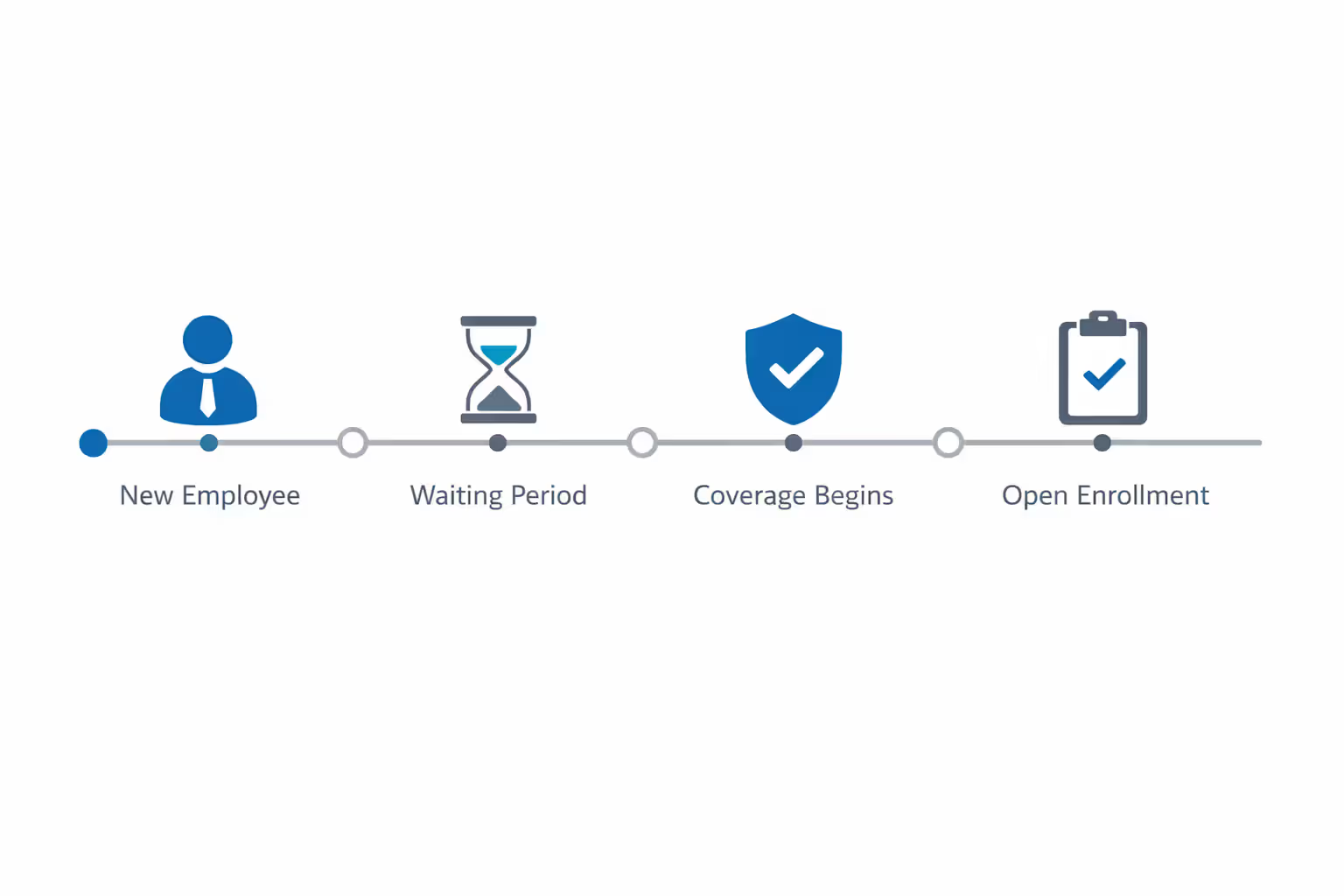
New hires can't wait more than 90 days for coverage access. You can impose a waiting period—many do—but benefits must kick in by the first day of the month after someone's been around 90 days. Some employers use 60 days, gaining a recruiting edge while keeping administration manageable.
Variable-hour workers—think retail, hospitality, anyone with unpredictable schedules—create headaches. Employers often use a 12-month measurement period tracking actual hours. Average 30+ weekly during measurement? You're offering coverage for the following stability period, no matter how few hours they work then.
Dependent coverage gets interesting. The mandate requires offering plans to employees' children through age 26. Spouses? Not required, though many employers include them anyway. Some even charge surcharges when a worker's spouse turns down their own employer's coverage.
Union contracts can reshape these rules entirely. Negotiated agreements might set different eligibility terms, waiting periods, or cost-sharing structures, provided the resulting coverage still meets federal minimums.
How Employer Health Insurance Requirements Work
Three standards determine compliance: minimum essential coverage, minimum value, and affordability. Miss any one? You're facing penalties.
Minimum essential coverage means real health insurance—HMOs, PPOs, high-deductible plans with HSAs, EPOs. Doctor visits, hospital stays, prescriptions, preventive care without copays, essential health benefits. Those supplemental policies like critical illness or hospital indemnity don't cut it alone.
For minimum value, your plan needs to cover 60% of healthcare costs for a typical population. Insurers usually provide calculators confirming this. Plans with sky-high deductibles sometimes fail despite seeming comprehensive. Offer coverage with a $15,000 individual deductible covering almost nothing until then? You might not hit that 60% threshold even if catastrophic expenses get covered.
Affordability looks only at employee-only premiums, not family costs. Three safe harbors let you prove affordability without knowing household income: W-2 wages (premium under 9.02% of Box 1 wages), rate of pay (premium under 9.02% of monthly wages from hourly rate × 130 hours), or federal poverty line (premium under 9.02% of FPL for one person—$14,580 in 2026).
Most companies use W-2 wages because it's straightforward. Pay someone $45,000 yearly? Keep their annual premium under $4,059 ($338.25 monthly) to satisfy affordability.
Form 1095-C goes to every full-time employee showing months coverage was available, whether it hit affordability and value benchmarks, and enrollment status. Form 1094-C transmits everything to the IRS with employer-wide data. Deadline for employees: March 2. IRS deadline: March 31 if paper filing, April 1 electronically, all following the coverage year.
Coverage Period and Enrollment Deadlines
Most plan years follow either the calendar (January through December) or the company's fiscal year. Calendar-year plans dominate since they match IRS reporting and individual marketplace timing, making life easier administratively.
Open enrollment happens once yearly, running at least two weeks though often four to six. October-November enrollment for January 1 start dates is common. During this window, eligible employees can join, switch plans, add or drop dependents, adjust voluntary benefits. Miss it? You're stuck until next year unless life throws you a qualifying event.
Author: Lauren Prescott;
Source: blaverry.com
Qualifying life events open special enrollment windows outside the annual period. Getting married, divorced, having or adopting a kid, losing other coverage, moving somewhere affecting plan availability—all qualify. Employees typically have 30 days from the event to request changes, though some plans allow 60.
New hires enroll once they satisfy eligibility rules. Someone hired March 15 with a 60-day wait becomes eligible May 15, coverage starting June 1. Employers provide enrollment materials and reasonable time—usually 30 days—to complete the process after eligibility begins.
COBRA extends group coverage to people losing benefits through job loss, hour reductions, divorce, or other qualifying events. Companies with 20+ employees must offer COBRA, letting individuals continue coverage 18 to 36 months by paying full premium plus 2% administrative fees. Election periods last 60 days from coverage loss or COBRA notice receipt, whichever comes later.
Employer Health Insurance Costs and Contributions
| Company Size | Employer Share (Individual) | Employee Share (Individual) | Employer Share (Family) | Employee Share (Family) |
| Small operations (3-49 workers) | 68% | 32% | 58% | 42% |
| Mid-sized firms (50-199 workers) | 78% | 22% | 65% | 35% |
| Large companies (200+ workers) | 82% | 18% | 71% | 29% |
Most employers cover 70-85% of employee-only premiums, with workers picking up the rest through paycheck deductions. Family coverage varies more—employers often pay a smaller slice of those higher premiums, leaving employees contributing $400-$800 monthly for family plans.
How companies split costs depends on size and industry. Bigger employers with bargaining clout often subsidize more heavily. Smaller businesses sometimes contribute fixed dollar amounts regardless of which plan tier employees select.
Typical premium split by company size, 2026
Since affordability measures only individual coverage, some employers heavily subsidize single premiums while requiring bigger employee contributions for family tiers. This satisfies the mandate while managing costs, though it can squeeze employees adding dependents.
Beyond premiums, you're paying for administration, broker commissions (typically 2-6% of premiums), COBRA paperwork, compliance consulting, and stop-loss insurance if self-funded. A 100-employee company might spend $850,000 on premiums but another $75,000 on administrative overhead.
Self-funding means paying claims directly instead of fixed premiums to an insurer, usually with stop-loss insurance capping catastrophic costs. It offers potential savings and design flexibility but requires cash reserves and administrative muscle. Companies with 200+ employees increasingly self-fund, while smaller operations typically can't handle claim volatility.

Author: Lauren Prescott;
Source: blaverry.com
Employer Health Insurance vs. Marketplace Coverage
Access to affordable employer coverage providing minimum value generally blocks premium tax credits for marketplace plans. This makes employer coverage the primary choice for most workers, even when marketplace plans might otherwise deliver better value.
| Feature | Employer-Sponsored Plan | Marketplace Plan |
| Who qualifies | Full-time workers meeting waiting periods | Any U.S. citizen or legal resident |
| Premium help | No individual subsidies (employer chips in) | Tax credits available by income without affordable employer offer |
| Plan choices | Limited to employer's selections (usually 2-4 options) | Multiple insurers and plan types across metal tiers |
| What you pay out-of-pocket | Varies; often lower deductibles due to employer funding | Varies by metal tier; cost-sharing reductions for lower incomes |
| Flexibility | Stuck with employer's network and benefits | Pick plan matching your needs and preferred doctors |
| When to enroll | Annual open enrollment plus new hire and qualifying events | Annual enrollment (Nov 1 - Jan 15) plus special periods |
The marketplace becomes relevant when employer coverage costs too much (employee-only premium exceeds 9.02% of household income) or fails minimum value. In those situations, workers can buy marketplace coverage and potentially qualify for premium subsidies and cost-sharing help based on income.
Some employees prefer marketplace plans for network access or specific coverage needs. Maybe your specialist isn't in the employer plan network. You can buy marketplace coverage instead—but without tax credits, marketplace plans usually cost significantly more than employer plans where the company pays most premiums.
Family coverage costs sometimes push people marketplaceward. When employer-sponsored family coverage runs $1,200 monthly with the employee paying $600, a family might find subsidized marketplace coverage more affordable, especially if income qualifies them for substantial credits. The "family glitch"—measuring affordability by employee-only premium even when family coverage is unaffordable—got partially fixed through rule changes letting family members access marketplace subsidies in some cases starting 2023, with broader eligibility afterward.
The employer mandate reshaped benefits strategy for mid-sized companies overnight. Many businesses that previously offered bare-bones coverage or nothing at all now provide comprehensive plans, but affordability calculations create genuine challenges when wages stagnate while premiums climb annually. Employers need sophisticated modeling balancing compliance requirements, cost control, and employee satisfaction—it's no longer a simple benefits decision
— Jennifer Martinez
Frequently Asked Questions
Employer health insurance requirements create a balancing act between business expenses, employee benefits, and regulatory compliance. Large employers face clear obligations to offer affordable coverage meeting minimum value standards, while smaller businesses navigate state-specific rules and competitive hiring pressures with more flexibility.
Knowing eligibility rules, enrollment windows, and cost-sharing structures helps employees maximize benefits and avoid gaps. The relationship between employer coverage and marketplace options requires careful analysis, particularly for families where employer-sponsored family coverage might be unaffordable despite affordable individual options.
Employers benefit from staying ahead of compliance—tracking FTE accurately, documenting coverage through proper IRS forms, regularly reviewing plan affordability as contribution percentages adjust annually. Penalties for non-compliance dwarf the cost of proper administration and benefits consulting.
Healthcare costs keep rising and regulations keep evolving, making annual review essential for employers and employees alike. Last year's optimal approach may not work now as plan designs shift, provider networks change, and household circumstances evolve. Investing time understanding these requirements and available options leads to better coverage decisions and fewer midyear surprises.