

Top-down view of a desk with health insurance documents, calculator, stethoscope, dollar bills, laptop showing charts, and coffee cup
What Is a Good Deductible for Health Insurance

Content
Choosing the right health insurance deductible feels like solving a puzzle with missing pieces. You're balancing monthly costs against potential medical expenses, trying to predict the unpredictable. Most people either overpay in premiums for peace of mind or gamble with high deductibles and hope nothing goes wrong.
A good deductible depends on three core factors: your monthly cash flow, how often you need medical care, and whether you can handle a financial surprise. For someone with $10,000 in savings and no prescriptions, a $5,000 deductible might work fine. That same deductible could devastate someone living paycheck to paycheck with chronic conditions.
The average individual deductible across employer-sponsored plans sits around $1,800 in 2026, while marketplace plans range from $500 to $9,100 depending on metal tier. These numbers mean nothing without context about your situation.
How Health Insurance Deductibles Work
Your deductible is the amount you pay out-of-pocket for covered services before your insurance starts sharing costs. If you have a $2,000 deductible, you pay the first $2,000 of medical bills yourself. After that, your plan typically covers a percentage through coinsurance, or you pay fixed copays.
Not everything counts toward your deductible. Preventive care—annual physicals, mammograms, colonoscopies—is covered at 100% before you meet your deductible thanks to ACA rules. Many plans also cover primary care visits and generic prescriptions with just a copay, bypassing the deductible entirely.
The deductible resets every January 1st. If you meet your $3,000 deductible in November, you start over from zero two months later. This timing matters when planning elective procedures or major treatments.
Here's where people get confused: meeting your deductible doesn't mean insurance covers everything. You'll still pay coinsurance (often 20% of costs) until you hit your out-of-pocket maximum. That maximum includes your deductible, coinsurance, and copays. Once you reach it, insurance covers 100% for the rest of the year.
Family deductibles work two ways. Some plans have an aggregate deductible—your family collectively pays one amount before anyone gets coverage. Others use an embedded deductible where each person has an individual limit, plus the family has a total cap. A family might have individual deductibles of $2,000 and a family deductible of $4,000. Once any family member hits $2,000, their care is covered. Once the family collectively pays $4,000, everyone's covered.
Factors That Determine Your Ideal Deductible
Your Monthly Budget vs. Emergency Savings
The premium-deductible tradeoff is simple: lower deductibles mean higher monthly premiums, and vice versa. A plan with a $1,000 deductible might cost $650 monthly, while a $5,000 deductible version costs $400. That's $3,000 in annual premium savings.
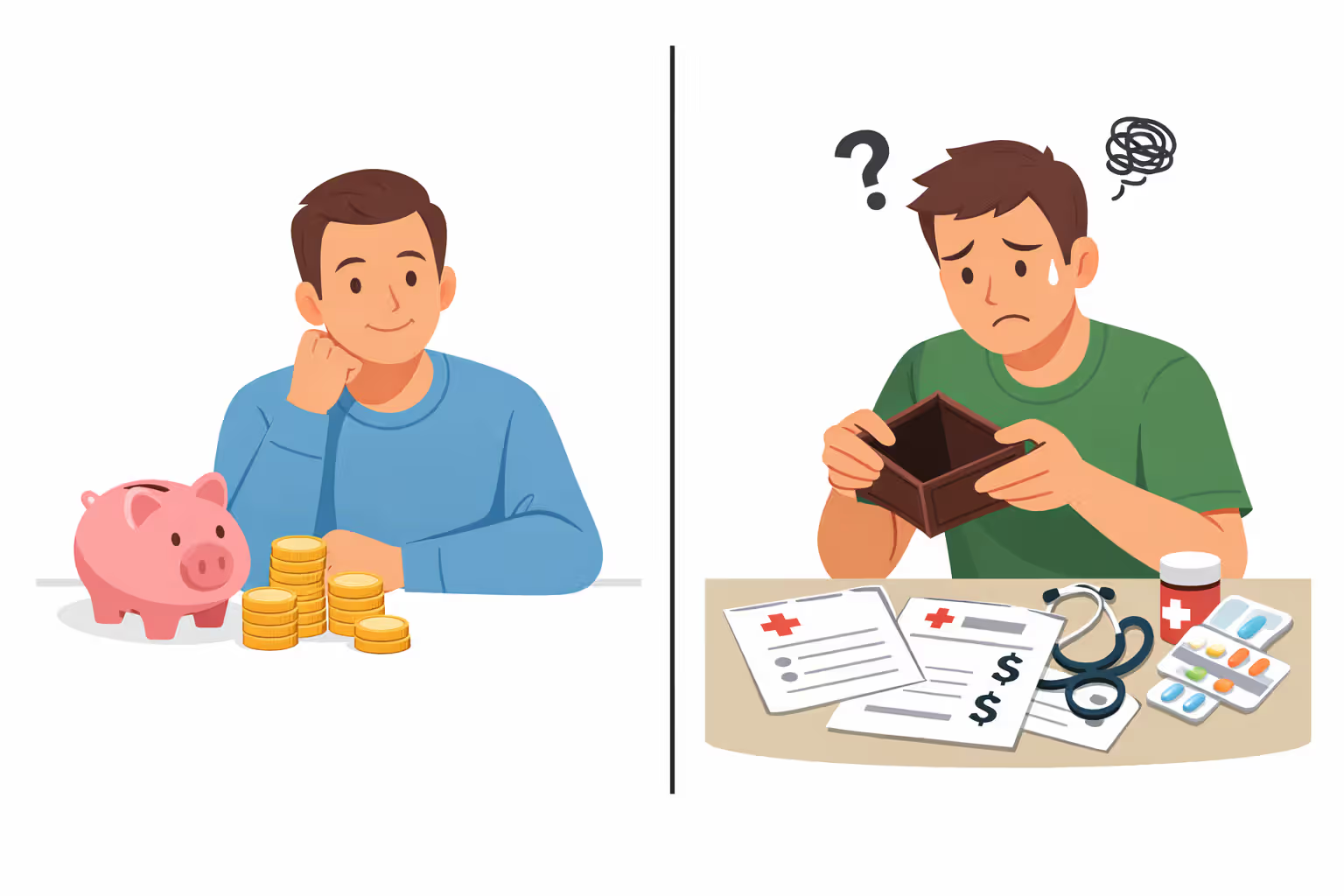
Calculate whether you can afford both scenarios. Can you consistently pay $650 monthly? If that premium strains your budget, you might skip care entirely—defeating the purpose of insurance. Can you access $5,000 if you need surgery in March? If not, the high-deductible plan becomes a trap.
Financial advisors suggest having your deductible amount in accessible savings. If you choose a $3,000 deductible, you should have $3,000 in an emergency fund or HSA. This isn't extra savings—it's the minimum cushion for your insurance choice to function.
Consider your cash flow stability. Freelancers with variable income face different risks than salaried employees. A $200 monthly premium difference matters more when your income fluctuates by thousands monthly.
Author: Derek Whitmore;
Source: blaverry.com
Expected Medical Needs and Prescriptions
Track what you spent on healthcare last year. Include prescriptions, specialist visits, physical therapy, imaging, and any procedures. If you spent $8,000 total and had a $2,000 deductible, you paid roughly $4,000 out-of-pocket after premiums.
Chronic conditions change the math completely. Managing diabetes might cost $3,000 annually in prescriptions and supplies alone. A low deductible with better prescription coverage could save thousands compared to paying full price until you meet a high deductible.
Pregnancy is expensive even with insurance. Average delivery costs run $10,000-$15,000 before insurance. With a $6,000 deductible and 20% coinsurance, you'd pay the $6,000 deductible plus 20% of the remaining balance—potentially $7,600 total. A $1,500 deductible plan with $200 higher monthly premiums ($2,400 annually) would cost far less overall.
Mental health treatment, physical therapy, and specialty medications push you toward lower deductibles. Six months of weekly therapy at $150 per session equals $3,900—blowing through most deductibles.
Risk Tolerance and Financial Cushion
Some people sleep better knowing they won't face a $5,000 bill. Others prefer gambling on staying healthy to save on premiums. Neither approach is wrong if you understand the stakes.
Risk tolerance isn't just emotional—it's financial. Someone with $50,000 in savings can absorb a high deductible without lifestyle disruption. Someone with $2,000 in the bank faces real consequences: skipped medications, delayed care, or debt.
Age plays a role. A healthy 28-year-old might reasonably choose a high deductible. A 58-year-old with family history of heart disease probably shouldn't. Medical needs become less predictable as you age.
Your backup options matter too. Can you borrow from family in an emergency? Do you have a second income source? These safety nets change whether a high deductible is smart or reckless.
High Deductible vs. Low Deductible Plans Compared
| Feature | High Deductible Plan | Low Deductible Plan |
| Monthly Premium | $350–$500 (individual) | $550–$750 (individual) |
| Typical Deductible | $3,000–$7,000 | $500–$1,500 |
| Out-of-Pocket Maximum | $7,000–$9,100 | $6,000–$8,000 |
| HSA Eligibility | Yes (if HDHP qualified) | No |
| Best For | Healthy individuals, high earners, those with savings | Frequent healthcare users, chronic conditions, families |
| Annual Cost (healthy year) | $4,200 premiums + $500 care = $4,700 | $6,600 premiums + $300 care = $6,900 |
| Annual Cost (major surgery) | $4,200 premiums + $7,000 max = $11,200 | $6,600 premiums + $6,000 max = $12,600 |
The break-even point typically falls around $2,000-$4,000 in annual medical expenses. Below that, high deductible plans cost less overall. Above that, low deductible plans often win.
High deductible health plans (HDHPs) offer HSA access—a powerful tool. You contribute pre-tax dollars, invest them tax-free, and withdraw tax-free for medical expenses. In 2026, individuals can contribute up to $4,300 annually, families up to $8,550. If your employer contributes $1,000 to your HSA and you save $2,400 in premiums, you've already covered a $3,400 deductible before paying anything out-of-pocket.
Low deductible plans make budgeting easier. You know your maximum exposure upfront. For someone managing multiple conditions, predictable costs prevent financial surprises that lead to skipped care.
Deductible Ranges by Plan Type
PPO (Preferred Provider Organization) plans typically feature deductibles between $1,000 and $3,000 for individuals. You get out-of-network coverage (after meeting a separate, higher deductible) and don't need referrals. The flexibility costs more in premiums. A PPO might charge $600 monthly with a $1,500 deductible.
HMO (Health Maintenance Organization) plans often have lower deductibles—$500 to $1,500—because they restrict you to network providers and require primary care referrals. Some HMOs have $0 deductibles but higher copays. Monthly premiums run $450-$550 for comparable coverage to a PPO. The tradeoff: less flexibility, more paperwork, but lower upfront costs.
EPO (Exclusive Provider Organization) plans split the difference with deductibles around $1,500-$2,500. No referrals needed, but zero out-of-network coverage except emergencies. Premiums fall between HMOs and PPOs.
HDHP (High Deductible Health Plans) must meet IRS minimums: $1,650 for individuals, $3,300 for families in 2026. Most exceed these minimums significantly, ranging from $3,000 to $7,000 for individuals. These plans pair with HSAs and appeal to healthy people or those who can afford to fund their HSA fully.
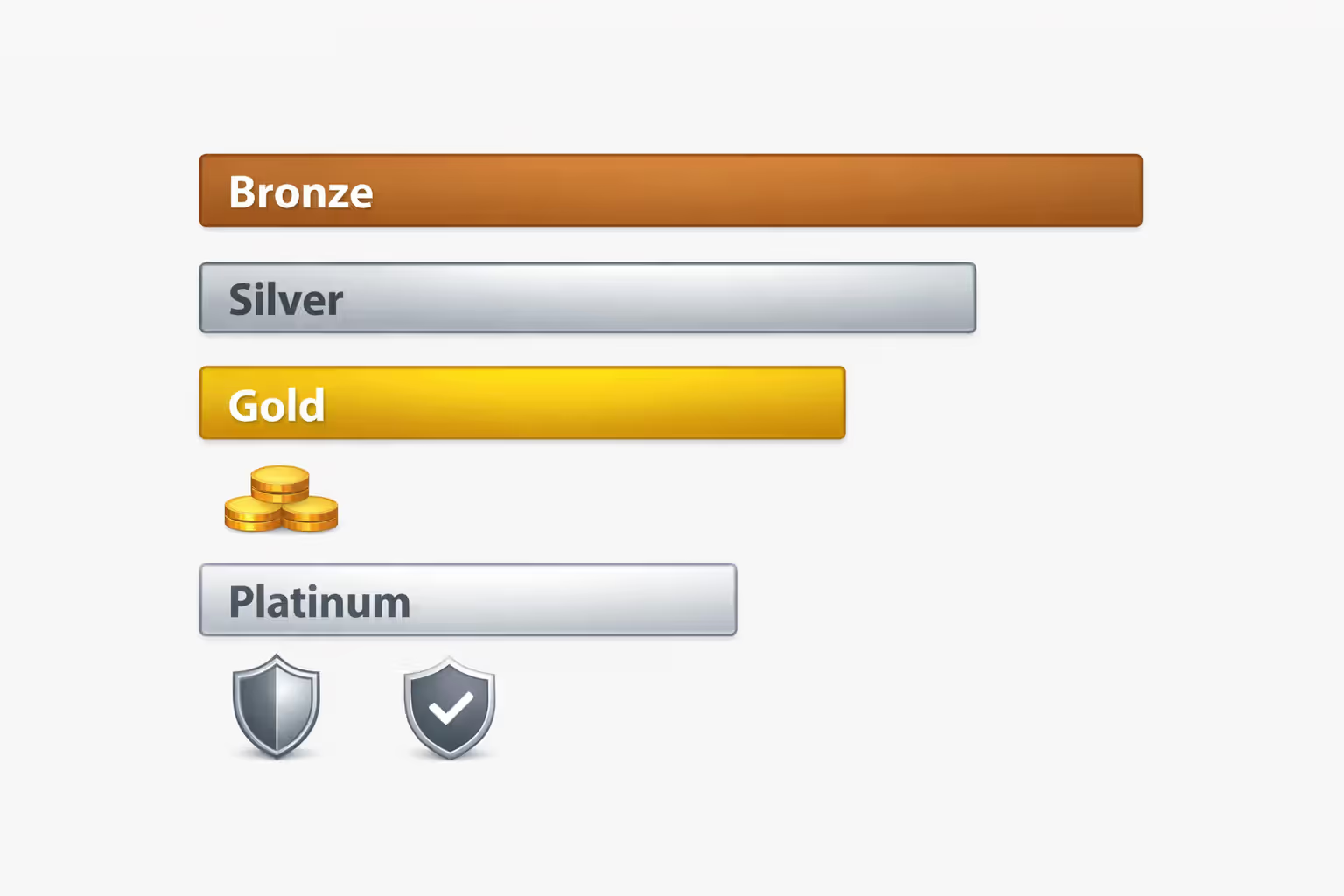
Marketplace bronze plans average $7,000-$8,500 deductibles with rock-bottom premiums. Silver plans hover around $4,500-$6,000. Gold plans drop to $1,000-$2,500 with higher premiums. Platinum plans may have $0-$500 deductibles but cost 40-60% more monthly than bronze.
Author: Derek Whitmore;
Source: blaverry.com
Common Deductible Selection Mistakes
Choosing based on premium alone is the most frequent error. A plan that's $150 cheaper monthly looks attractive until you need an MRI. That $1,800 annual savings evaporates when you pay full price for a $2,500 imaging test because you haven't met your deductible.
Ignoring the out-of-pocket maximum creates false security. You might focus on a $2,000 deductible and miss that the out-of-pocket max is $8,900. After meeting your deductible, you'll pay 20% coinsurance on everything until you hit that maximum. A $50,000 surgery costs you $2,000 (deductible) plus 20% of $48,000 ($9,600), but the out-of-pocket max caps you at $8,900 total. Know both numbers.
Not accounting for family size leads to undercoverage. Your family of four needs more than a plan optimized for a single person. Family deductibles double or triple individual amounts. A $3,000 individual deductible might become a $6,000 family deductible. If three family members need care, you're paying until you hit that family amount.
Overestimating your health happens constantly. People think "I never go to the doctor" and choose high deductibles, then face unexpected diagnoses. You can't predict appendicitis, car accidents, or sudden illness. Build in a margin of error.
Underestimating prescription costs before meeting your deductible surprises many. That specialty medication might be $800 monthly until you meet your deductible, then $50 with insurance. Six months at full price equals $4,800—suddenly your high deductible plan costs more than a low deductible option with better prescription coverage from day one.
Forgetting about preventive care causes people to skip valuable benefits. They don't realize annual checkups, vaccines, and screenings are free regardless of deductible status. Missing these benefits means catching problems later when they're expensive.

Author: Derek Whitmore;
Source: blaverry.com
How to Calculate Your Break-Even Point
Start by gathering real numbers from plan options. You need monthly premiums, deductibles, coinsurance rates, and out-of-pocket maximums for each plan you're comparing.
Step 1: Calculate annual premiums. Multiply monthly premium by 12. Plan A at $400 monthly costs $4,800 annually. Plan B at $600 monthly costs $7,200 annually—a $2,400 difference.
Step 2: Estimate your medical expenses. Use last year as a baseline, adjusting for known changes (planned surgery, new prescription, pregnancy). Be conservative—assume slightly more than you think.
Step 3: Calculate out-of-pocket costs for low-use scenario. Assume you only need preventive care and maybe one sick visit. Plan A might cost $200 (one copay), Plan B might cost $50 (lower copay). Add these to annual premiums: Plan A totals $5,000, Plan B totals $7,250.
Step 4: Calculate out-of-pocket costs for moderate-use scenario. Assume $5,000 in medical bills. With Plan A's $5,000 deductible, you pay all $5,000 plus $4,800 premiums = $9,800 total. With Plan B's $1,500 deductible and 20% coinsurance, you pay $1,500 + 20% of remaining $3,500 ($700) + $7,200 premiums = $9,400 total.
Step 5: Calculate worst-case scenario using out-of-pocket maximums. Plan A caps at $8,500 out-of-pocket plus $4,800 premiums = $13,300 maximum annual cost. Plan B caps at $6,500 plus $7,200 = $13,700 maximum.
Step 6: Find the break-even point. In this example, Plan A wins if you spend under $3,000 on healthcare. Plan B wins between $3,000-$8,000 in medical costs. Above $8,000, they're nearly equal because both hit out-of-pocket maximums.
The break-even point is where total annual costs equal each other. It's the medical expense level where switching plans makes financial sense.
The right deductible isn't about finding the lowest number—it's about matching your financial reality to your health needs. I've seen too many people choose high deductibles to save $100 monthly, then skip necessary care because they can't afford the $5,000 deductible. That's not insurance working—that's insurance failing
— Jennifer Fitzgerald
Frequently Asked Questions
Choosing a good deductible means running the numbers with honest assumptions about your health and finances. The "best" deductible balances what you can afford monthly against what you could handle in a medical emergency.
Start with your budget constraints. If paying $700 monthly for insurance would force you to skip other bills, that plan won't work regardless of its low deductible. If you can't access $4,000 within a month, don't choose a $4,000 deductible.
Factor in your medical history and upcoming needs. Past healthcare spending predicts future costs better than wishful thinking. Add a 20% buffer for unexpected issues.
Consider your financial safety net beyond just savings. Job stability, family support, and other insurance (disability, accident) all affect how much risk you can handle.
Remember that the cheapest option today might cost more tomorrow. A $300 monthly premium with a $6,000 deductible saves money only if you stay healthy. One emergency room visit or unexpected diagnosis can flip that equation instantly.
The right deductible gives you coverage you'll actually use without causing financial hardship. It's not about finding the perfect number—it's about finding your number based on your reality, not someone else's spreadsheet.